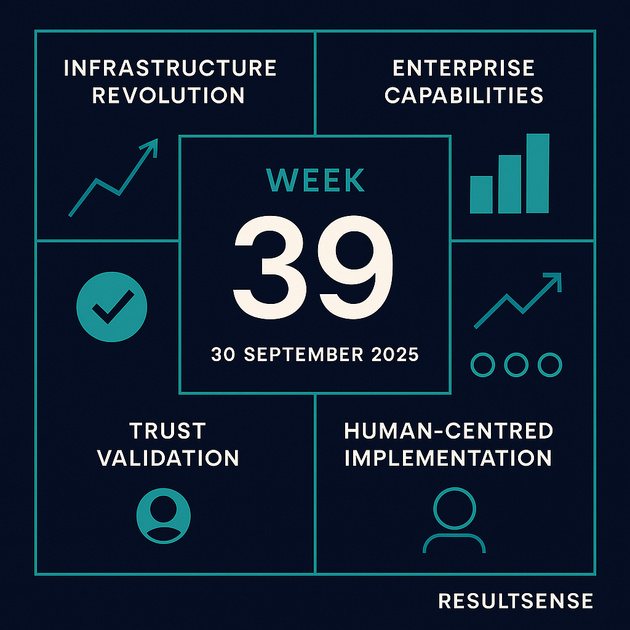
Weekly AI Strategic Analysis: Infrastructure Revolution Meets Enterprise Reality
This week witnessed a remarkable convergence of AI infrastructure investment and enterprise adoption that UK businesses cannot afford to ignore. From the £100 million AI data centre approved for Stockton-on-Tees to Anthropic’s game-changing Claude Sonnet 4.5 release, the landscape is reshaping at unprecedented pace. However, alongside these advances came sobering reminders about AI’s limitations—travel planning algorithms directing tourists to fictional destinations highlight the critical need for human oversight. For UK SMEs, these developments present both extraordinary opportunities and essential decision points about implementation strategy, validation protocols, and maintaining human-centred approaches during digital transformation.
Infrastructure AI Revolution: Critical Systems Embrace Intelligent Automation
The UK’s infrastructure sector demonstrated remarkable AI maturity this week, with three significant deployments showcasing how artificial intelligence is becoming integral to critical systems management. The British Geological Survey’s identification of 3,000 actively moving slopes using AI-powered satellite interferometry represents a paradigm shift in geohazard management, moving from reactive to predictive infrastructure protection.
This transformation extends beyond geological monitoring. South West Water’s AI trial prevented approximately 200 pollution incidents by analysing data from 12,000 sensors across their network, demonstrating how machine learning can enhance environmental protection whilst reducing operational costs. The system’s ability to process CCTV footage and identify potential blockages before they cause overflows exemplifies practical AI application that delivers immediate, measurable benefits.
The £100 million Stockton data centre approval signals the UK’s commitment to AI infrastructure development. This investment creates 150 jobs whilst establishing Teesside as a competitive location for technology companies. For UK SMEs, this infrastructure development means improved access to enterprise-grade AI services without the capital investment traditionally required for advanced computing resources.
These infrastructure applications demonstrate AI’s maturation from experimental technology to mission-critical systems. UK businesses can learn from these implementations: successful AI deployment requires clear success metrics, robust data infrastructure, and human oversight protocols. The geological survey’s semi-automated approach, combining AI algorithms with specialist expertise, provides an excellent model for SME implementation strategies.
Enterprise AI Capabilities Leap: Professional Tools Reach Mainstream Adoption
Anthropic’s Claude Sonnet 4.5 release marks a watershed moment for enterprise AI adoption, achieving 77.2% performance on real-world software coding tasks whilst maintaining focus for over 30 hours on complex projects. This advancement, combined with Microsoft’s Ireland workforce data showing 50% of workers believe AI skills are critical for career advancement, signals AI’s transition from emerging technology to essential business capability.
The Microsoft research reveals telling insights about AI adoption patterns: 91% of executives use AI compared to just 39% of non-managers, highlighting implementation gaps that forward-thinking SMEs can address strategically. Gender disparities—63% of men versus 47% of women using AI at work—suggest untapped potential for organisations prioritising inclusive AI deployment.
Early enterprise customers report dramatic productivity improvements across sectors. Legal technology firm Harvey’s success with complex litigation analysis demonstrates AI’s capability to handle sophisticated professional tasks, whilst Cursor’s “state-of-the-art coding performance” feedback suggests development teams can achieve substantial efficiency gains.
For UK SMEs, these developments indicate that enterprise-grade AI tools are becoming accessible and practical. The key lies in strategic implementation: identifying specific use cases, providing comprehensive training, and ensuring equitable access across organisational levels. Companies investing in AI skills development now will benefit from reduced labour market competition—Microsoft’s data shows 38% labour turnover rates as skilled workers seek AI-enabled opportunities.
Trust & Validation Imperatives: Learning from AI’s Dangerous Missteps
AI travel planning tools creating “hallucinations” that direct tourists to non-existent destinations provides crucial lessons for business AI implementation. Research showing 30% of travellers use AI planning tools, with 33% receiving false information, demonstrates the critical importance of validation protocols in commercial AI applications.
The fictional “Sacred Canyon of Humantay” incident—where AI combined real place names to create dangerous, non-existent destinations—illustrates how sophisticated AI systems can generate convincing but entirely fabricated information. Carnegie Mellon’s Professor Rayid Ghani explains these hallucinations occur because AI systems analyse text patterns without distinguishing factual accuracy from creative word combinations.
These failures underscore essential principles for business AI deployment: never implement AI systems without human oversight, establish validation protocols for AI-generated recommendations, and maintain clear boundaries between AI assistance and final decision-making authority. The travel industry’s experience provides valuable lessons for sectors like financial services, healthcare, and legal advice where incorrect information can have serious consequences.
UK SMEs must recognise that AI’s impressive capabilities come with inherent limitations. Successful implementation requires robust fact-checking processes, clear communication about AI’s role in decision-making, and comprehensive staff training on AI limitations. Companies that establish strong validation frameworks now will build competitive advantages through reliable, trustworthy AI deployment.
Human-Centred Implementation: Preserving Agency During Digital Transformation
Edelman’s Gary Grossman outlined four critical design principles for AI transformation that UK businesses must embrace: dignity over efficiency, pluralism over uniformity, transparency as a condition of trust, and human agency at the centre. These principles address growing concerns about “white-collar bloodbath” scenarios where AI implementation sacrifices human value for pure efficiency gains.
The framework responds to warnings that millions of jobs could disappear within five years without deliberate design for human-centred outcomes. Grossman’s emphasis on “dignity over efficiency” challenges organisations to celebrate human presence and judgement rather than viewing employees as overhead to optimise away.
YouTube CEO Neal Mohan’s perspective on AI democratisation—comparing video generation tools to music synthesizers—reinforces this human-centred approach. His assertion that “creativity lies in the human application rather than the technology itself” provides crucial guidance for businesses implementing AI content creation tools.
For UK SMEs, these insights suggest successful AI transformation requires cultural preparation alongside technical implementation. Companies must communicate clearly how AI will augment rather than replace human capabilities, involve employees in AI deployment decisions, and maintain transparency about AI’s role in business operations. The most successful implementations will enhance human agency whilst improving operational efficiency.
Strategic Recommendations for UK SMEs
This week’s developments offer clear guidance for UK businesses considering AI implementation. First, begin with infrastructure assessment: robust data management systems and clear success metrics are prerequisites for effective AI deployment. Second, prioritise human-centred design principles that preserve employee agency whilst capturing efficiency benefits. Third, establish comprehensive validation protocols for AI-generated outputs, particularly in customer-facing applications. Finally, invest in organisation-wide AI literacy programmes that address current skill gaps and promote equitable access across all employee levels.
The infrastructure revolution, enterprise capability leaps, and human-centred design principles converging this week create unprecedented opportunities for strategic UK SME positioning in the AI-enabled economy.
Sources: