Three years after ChatGPT’s launch, Yale researchers have confirmed what many suspected but few dared hope: artificial intelligence hasn’t triggered the feared wave of mass job displacement. The occupational mix is changing at essentially the same pace as during previous technological transitions—computers in the 1980s, the internet in the late 1990s. Yet this apparent stability masks a far more urgent strategic reality that most organisations are dangerously underestimating.
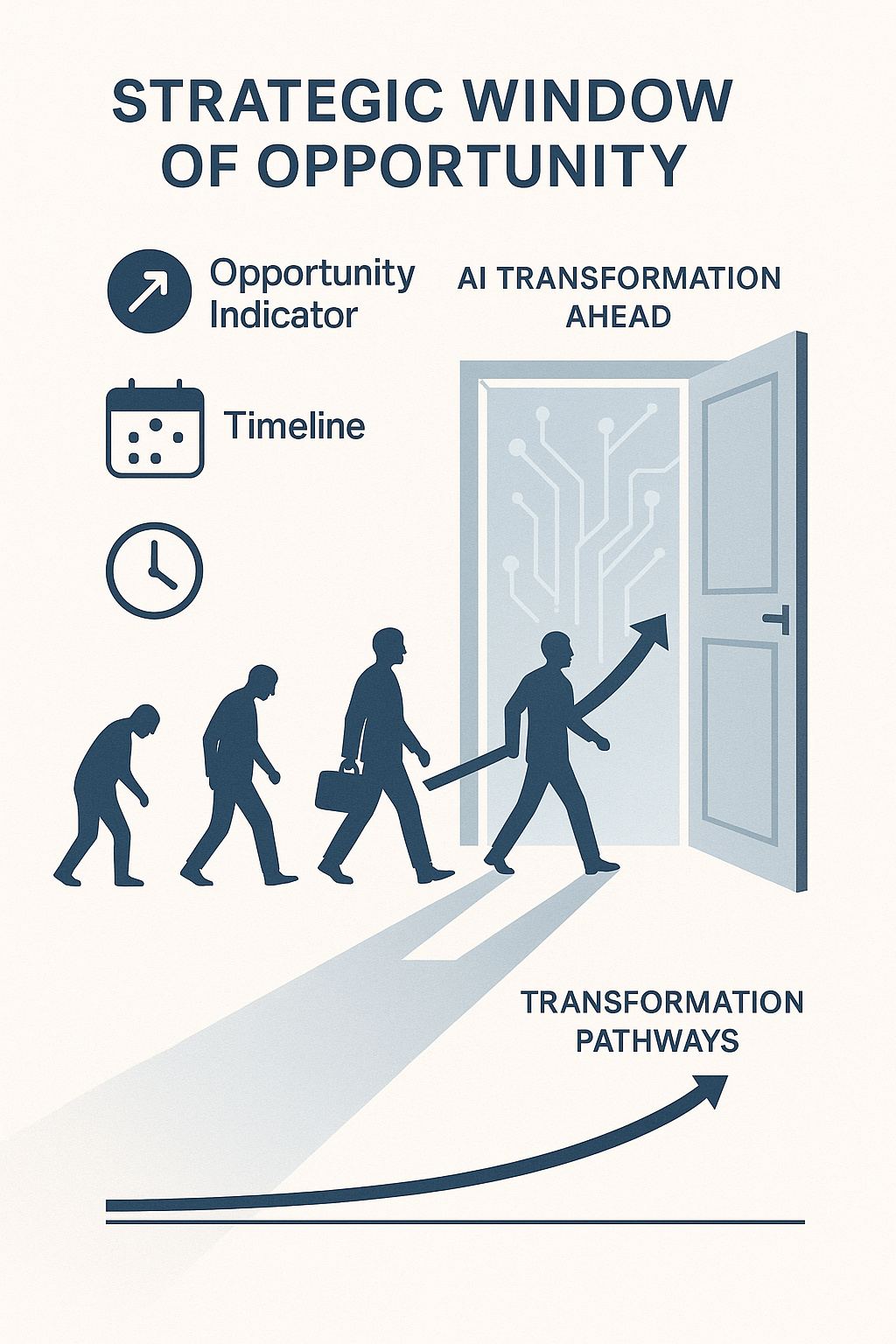
The absence of immediate disruption isn’t evidence of low impact—it’s a temporary strategic window during which organisations can either position themselves for transformation or become casualties of their own complacency.
Whilst the Labour market appears stable on the surface, the data reveals a troubling paradox: 68% of enterprises have experienced AI-related data leakage incidents, yet only 23% have implemented comprehensive security policies. The average enterprise now operates 125 separate SaaS applications, creating a sprawling attack surface that traditional governance frameworks never anticipated. This disconnect between adoption speed and governance maturity represents the real crisis—not job losses, but the systematic erosion of organisational control over AI deployment.
The Paradox of Stability in Times of Change
Yale’s Budget Lab analysis tracked occupational changes across 33 months since ChatGPT’s November 2022 release, comparing this period to previous technological disruptions. Their findings challenge the apocalyptic narratives whilst revealing subtler, more strategically significant patterns that business leaders must understand.
The Real Story Behind the Headlines
Historical precedent suggests that widespread technological disruption unfolds over decades, not months. Computers didn’t become commonplace in offices until nearly a decade after their public release, and transforming office workflows took even longer. The current 33-month observation period represents an early snapshot of what will likely prove a multi-decade transformation. Organisations interpreting stability as permanence fundamentally misunderstand the nature of technological adoption curves.
More concerning is the growing gap between AI exposure (theoretical impact) and AI usage (actual deployment). Research comparing OpenAI’s exposure metrics with Anthropic’s Claude usage data reveals limited correlation. Computer and mathematical occupations—particularly coders—dominate actual AI usage far beyond their theoretical exposure rankings, whilst clerical sectors with similar exposure levels show minimal adoption. This uneven deployment pattern suggests that current disruption metrics systematically underestimate future impact by aggregating stagnant sectors with rapidly transforming ones.
Critical Numbers: The State of AI in Labour Markets
| Metric | Finding | Strategic Implication |
|---|---|---|
| Occupational mix change | ~7% different from baseline after 33 months | Similar to internet adoption (1996-2002), suggesting gradual transformation |
| Enterprise data leakage | 68% experienced AI-related incidents | Governance failure represents immediate crisis, not future concern |
| Security policy coverage | Only 23% have comprehensive policies | Strategic window for proactive governance rapidly closing |
| Average SaaS applications | 125 per enterprise | Complexity exceeds governance capacity, creating systematic risk |
The Yale research confirms that exposure to generative AI shows no correlation with unemployment rates across occupational categories. Workers in high-exposure occupations exhibit stable employment patterns compared to low-exposure groups. Even when examining unemployed workers by duration, no clear relationship emerges between AI exposure and joblessness. This stability, however, reflects current adoption patterns, not future trajectories.
Understanding the Implementation Reality
What’s Really Happening: Beyond Surface Stability
The apparent Labour market stability obscures three critical dynamics that forward-thinking organisations must address immediately:
First, adoption velocity varies dramatically by sector and occupation. Software developers and technical writers have integrated AI deeply into daily workflows, achieving productivity gains of 30-40% for specific tasks. Meanwhile, administrative and clerical roles—theoretically exposed at similar levels—show minimal AI usage. This adoption gap creates a false sense of security in aggregate statistics whilst certain occupational categories undergo rapid transformation beneath the surface.
Second, the gap between potential and actual usage reveals strategic bottlenecks. OpenAI’s exposure metrics suggest which jobs could theoretically be impacted, whilst Anthropic’s usage data shows which jobs actually use AI today. The disconnect between these measures indicates that barriers to adoption—not lack of capability—constrain AI’s current impact. These barriers include inadequate training, unclear use cases, governance concerns, and technical integration challenges. Organisations that systematically address these barriers position themselves for competitive advantage.
The current calm isn’t equilibrium—it’s the organisational equivalent of a bathtub filling slowly from a fully open tap. Once the water level reaches critical mass, transformation accelerates exponentially, not gradually.
Third, enterprise AI sprawl creates systemic risk independent of job displacement. The average organisation now operates 125 SaaS applications, many incorporating AI capabilities without formal governance oversight. This creates what security researchers term “shadow AI”—unauthorised tools that employees adopt to solve workflow problems, often bypassing official procurement and security review processes. The 68% data leakage rate reflects this governance failure, not technological inadequacy.
Success Factors Often Overlooked
- Velocity over volume matters more than aggregate adoption rates. Focus on transformation speed within specific occupational categories rather than economy-wide averages.
- Governance capacity determines competitive advantage. Organisations that establish robust AI governance frameworks today will move faster tomorrow when adoption accelerates.
- Usage data reveals more than exposure metrics. Track actual deployment patterns within your organisation rather than relying on theoretical impact assessments.
- Employee experimentation signals unmet workflow needs. Shadow AI adoption represents valuable feedback about process inefficiencies that formal systems should address.
The Implementation Reality: Why Most Organisations Will Fail
Most AI governance initiatives fail not from lack of policy sophistication but from misalignment between policy design and operational reality. Traditional governance frameworks assume controlled, centralised technology adoption—a deployment model that AI categorically rejects.
Modern AI tools arrive via SaaS subscriptions, browser extensions, and API integrations that bypass traditional IT procurement. Employees adopt these tools to solve immediate workflow problems, often without understanding data handling implications or security risks. By the time governance teams identify the adoption, business processes have already adapted around the tools, making removal disruptive.
⚠️ Critical Warning: Organisations treating AI governance as a compliance exercise rather than a strategic capability will face compounding disadvantage. Every month of delayed governance implementation increases technical debt, expands security exposure, and reduces future strategic options.
The solution requires rethinking governance as user experience rather than policy enforcement. The most effective frameworks embed compliance requirements directly into workflows through intuitive interfaces—what researchers term “policy-as-UX.” This approach uses contextual warnings, safe-paste interstitials, and automated guardrails to guide users towards compliant AI usage whilst preventing risky behaviours. When correct behaviour becomes easier than workarounds, compliance follows naturally.
The Human Factor: Organisational Transformation Beyond Technology
Beyond the Technology: Understanding Organisational Dynamics
The Yale research reveals that recent college graduates (ages 20-24) show slightly faster occupational mix changes compared to older graduates (ages 25-34). This pattern, whilst modest in magnitude, suggests early-career workers may experience different AI impacts than established professionals. However, small sample sizes and the Current Population Survey’s noise characteristics warrant cautious interpretation.
More significant is the distributional impact across occupational categories. Information sectors show larger occupational mix shifts than the aggregate labour market, though these trends predated ChatGPT’s release. Professional and business services sectors exhibit similar patterns. This sectoral variation indicates that AI’s impact will likely concentrate in specific industries and occupational categories rather than distributing evenly across the economy.
Stakeholder Impact Analysis
| Stakeholder Group | Primary Impact | Support Needs | Success Metric |
|---|---|---|---|
| Executive Leadership | Strategic positioning vs. competitors; governance accountability | Clear frameworks for AI investment decisions; risk management protocols | Competitive advantage maintained; no significant security incidents |
| Middle Management | Workflow redesign; team productivity optimisation | Training on AI tool selection; change management support | Process efficiency gains; employee satisfaction maintained |
| Individual Contributors | Task automation; skill relevance | Reskilling opportunities; clear guidance on appropriate AI usage | Productivity improvements; job security confidence |
| IT/Security Teams | Infrastructure scaling; security policy enforcement | Resources for governance implementation; vendor evaluation tools | Adoption velocity without security compromise |
What Actually Drives Success: Redefining Strategic Priorities
Traditional success metrics—headcount reduction, cost savings, automation rates—miss the strategic point entirely. The organisations that will thrive in the AI era focus on different measures:
Governance velocity: How quickly can your organisation identify new AI capabilities, evaluate security implications, and provide approved pathways for employee adoption? Organisations measuring this in weeks rather than months demonstrate strategic maturity.
Adoption quality: What percentage of AI tool usage follows approved patterns with appropriate human oversight? High-quality adoption means employees use AI effectively within governance guardrails, not that they avoid AI entirely.
Strategic optionality: How many viable paths forward does your current AI architecture preserve? Organisations that lock into specific vendor ecosystems or rigid architectural patterns sacrifice future flexibility for short-term simplicity.
🎯 Success Redefined: The winning organisations won’t be those that avoided AI disruption—they’ll be those that converted adoption chaos into structured competitive advantage whilst competitors remained paralysed by governance inertia.
Building Your Strategic Response Framework
A Practical Implementation Roadmap
💡 Three-Phase Framework:
Phase 1 (Weeks 1-4): Establish Baseline Understanding
- Audit current AI tool adoption (sanctioned and shadow)
- Identify high-risk usage patterns and immediate vulnerabilities
- Document current governance gaps and quick-win opportunities
Phase 2 (Weeks 5-12): Deploy Minimum Viable Governance
- Implement policy-as-UX approach for high-usage scenarios
- Establish approved tool catalogue with clear use cases
- Create rapid evaluation pathway for new tool requests
Phase 3 (Weeks 13-24): Build Strategic Capability
- Develop centre of excellence for AI implementation guidance
- Establish feedback loops for continuous governance refinement
- Create measurement frameworks linking AI usage to business outcomes
Priority Actions for Different Organisational Contexts
For Organisations Just Starting Their AI Journey:
-
Conduct usage audit before policy creation. Understand current shadow AI adoption patterns to design governance that addresses actual employee needs rather than theoretical risks. Use this data to identify workflow inefficiencies that formal AI tools should address.
-
Implement approved tool catalogue with clear pathways. Provide sanctioned alternatives for common use cases (document summarisation, writing assistance, data analysis) that meet security requirements. Make approved tools easier to use than unauthorised alternatives.
-
Establish rapid evaluation process for new tools. Create pathway for employees to request evaluation of new AI capabilities with clear timelines and approval criteria. Speed matters—lengthy approval processes drive continued shadow adoption.
For Organisations Already Underway with AI Implementation:
-
Transition from policy enforcement to capability building. Move beyond “thou shalt not” governance towards enabling teams to use AI effectively within appropriate guardrails. Invest in training that demonstrates value rather than highlighting risks.
-
Implement systematic usage monitoring with feedback loops. Deploy tools that provide visibility into AI adoption patterns across the organisation without creating surveillance culture. Use insights to refine governance based on actual usage patterns rather than theoretical concerns.
-
Develop internal expertise for prompt engineering and context management. Build capacity within teams to optimise AI tool effectiveness through proper prompt design and context provision. This capability multiplies value from approved tools whilst reducing pressure to seek unauthorised alternatives.
For Advanced AI-Mature Organisations:
-
Architect for strategic optionality rather than current efficiency. Design AI infrastructure that preserves ability to adopt new capabilities and switch vendors as technology evolves. Avoid architectural decisions that create future lock-in for marginal current gains.
-
Establish governance-as-platform approach. Move beyond tool-specific policies towards systematic frameworks that can quickly evaluate and incorporate new AI capabilities as they emerge. Build reusable evaluation protocols and risk assessment frameworks.
-
Create organisation-wide AI literacy programme. Develop capability across all functions to identify opportunities, evaluate solutions, and implement responsibly. Make AI competency a core organisational skill rather than specialist domain.
The Challenges Nobody’s Discussing
Challenge 1: The Data Leakage Time Bomb
Whilst organisations debate theoretical job displacement, a more immediate crisis unfolds: systematic data leakage through improperly governed AI tool usage. The 68% incident rate reported in Yale’s research reflects employees pasting sensitive information into public AI interfaces, often unknowingly.
Mitigation Strategy: Implement technical controls that detect and block sensitive data before it reaches AI interfaces. Deploy browser extensions or gateway solutions that scan clipboard contents for patterns matching financial information, personal data, or proprietary material. Combine technical controls with contextual education explaining why certain data types create risk.
Challenge 2: The Measurement Paradox
Current metrics systematically underestimate AI’s organisational impact by aggregating sectors with vastly different adoption velocities. Economy-wide statistics showing minimal disruption provide false reassurance to organisations in rapidly transforming sectors.
Mitigation Strategy: Develop sector-specific and occupation-specific metrics rather than relying on aggregate indicators. Establish peer groups of similar organisations facing comparable AI transformation pressures. Monitor leading indicators like skill requirement changes in job postings, productivity metrics for AI-exposed tasks, and competitor adoption patterns.
Challenge 3: The Strategic Inertia Trap
The apparent stability of current labour market metrics creates organisational inertia precisely when strategic repositioning becomes most valuable. Leaders interpreting stability as validation for minimal AI investment fundamentally misread the data.
Mitigation Strategy: Reframe AI governance as competitive positioning rather than risk mitigation. Model scenarios where competitors achieve 20-30% productivity improvements in specific functions through systematic AI adoption. Calculate the competitive disadvantage of maintaining current approaches whilst peer organisations systematically improve efficiency.
Challenge 4: The Vendor Ecosystem Lock-In
Organisations racing to implement AI solutions often inadvertently create vendor dependencies that constrain future strategic options. The rapid evolution of AI capabilities makes architectural flexibility extraordinarily valuable, yet many implementation approaches sacrifice optionality for immediate capability.
Mitigation Strategy: Design AI infrastructure with abstraction layers that enable vendor switching without business process disruption. Prioritise solutions using open standards and interoperable APIs. Regularly evaluate switching costs for critical systems to ensure strategic flexibility remains viable.
Your Strategic Imperative: Act Now, Before the Window Closes
The core insight from Yale’s research isn’t that AI won’t disrupt labour markets—it’s that disruption unfolds gradually, then suddenly. Organisations have perhaps 18-36 months to establish governance frameworks, build internal capabilities, and position strategically before adoption accelerates beyond controlled management.
Three Critical Success Factors
-
Governance velocity trumps governance sophistication. A functional governance framework deployed in 30 days provides more strategic value than a perfect framework requiring 6 months. Speed matters because every week of delay allows ungoverned adoption to expand.
-
Usage quality exceeds usage quantity. Focus on ensuring existing AI adoption follows appropriate patterns with suitable human oversight rather than maximising adoption metrics. Quality adoption builds foundation for sustainable scaling.
-
Strategic optionality preserves competitive advantage. Architectural decisions that maintain flexibility across vendors, deployment models, and implementation approaches matter more than marginal efficiency gains from deeply integrated solutions.
Reframing Success: From Risk Mitigation to Strategic Positioning
Traditional organisations view AI governance as downside protection—preventing data breaches, avoiding compliance violations, minimising reputation damage. This defensive framing fundamentally misunderstands the strategic opportunity.
Forward-thinking organisations recognise that the real risk isn’t moving too quickly with AI—it’s moving too slowly whilst competitors systematically improve productivity, customer experience, and operational efficiency.
The organisations that will dominate their sectors five years from now are those treating this apparent stability not as permission for inaction but as a strategic gift—a temporary window for building capability before transformation accelerates.
Your Next Steps: A Practical Implementation Checklist
Immediate Actions (This Week):
- Audit current AI tool usage across your organisation, including shadow adoption
- Identify three high-risk usage patterns requiring immediate attention
- Document quick-win opportunities where governed AI tools would address current workflow friction
Strategic Priorities (This Quarter):
- Establish approved AI tool catalogue with clear use cases and access pathways
- Implement policy-as-UX approach for highest-usage scenarios
- Create rapid evaluation process for new AI capabilities with defined timelines
Long-term Considerations (This Year):
- Build internal centre of excellence for AI implementation guidance
- Develop organisation-wide AI literacy programme across all functions
- Design measurement frameworks linking AI usage to specific business outcomes
Source: Evaluating the Impact of AI on the Labour Market: Current State of Affairs
This strategic analysis was developed by Resultsense, providing AI expertise by real people.