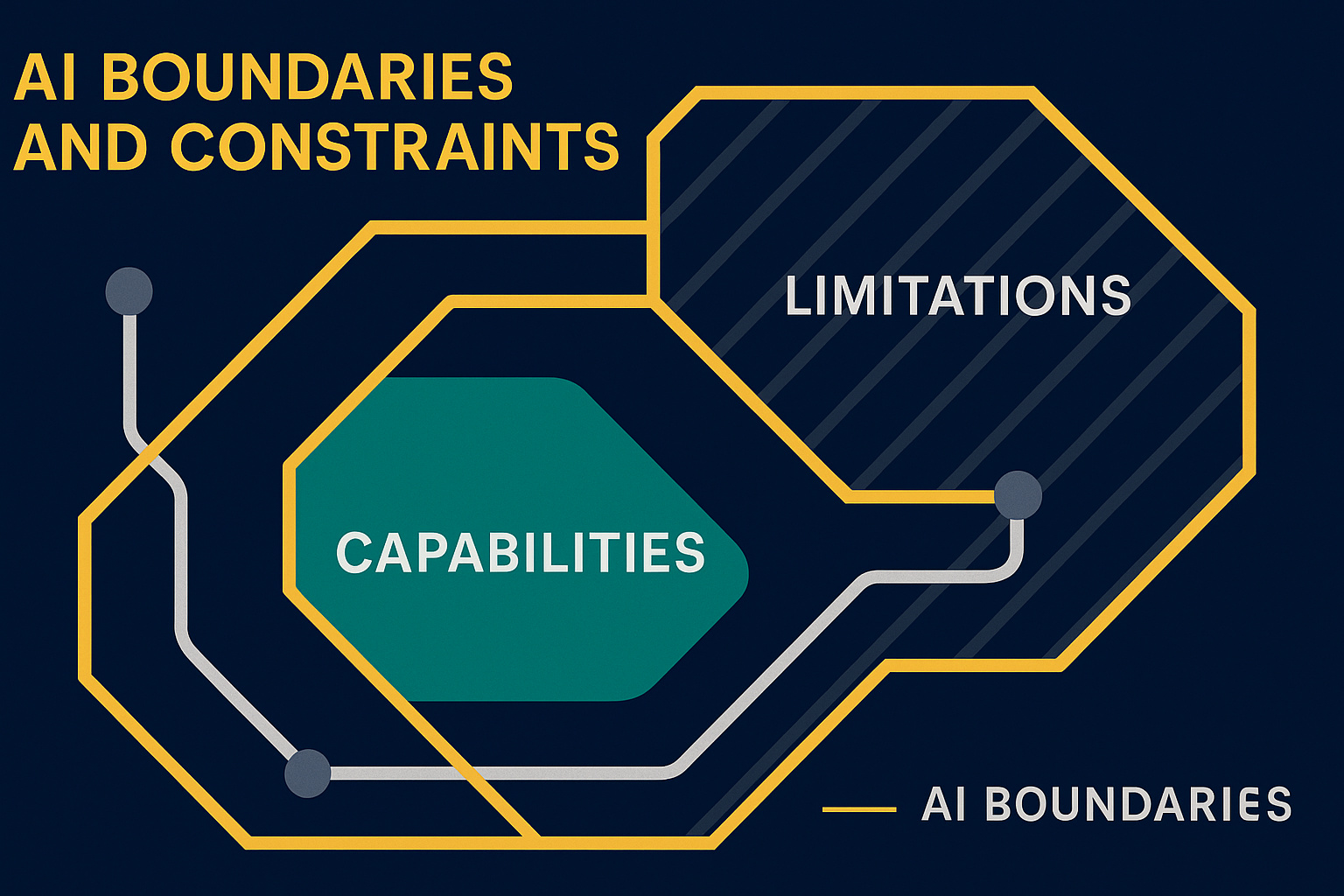
Eight research-validated constraints currently prevent AI systems from automating most cognitive labour—the threshold commonly termed “Artificial General Intelligence” (AGI). The UK AI Security Institute’s systematic review of expert interviews, academic literature, and field experiments reveals fundamental limitations that reshape strategic implementation priorities for organisations considering AI adoption.
Strategic Insight: Organisations investing in human-AI partnership models rather than pure automation gain sustainable advantage. These eight limitations aren’t temporary barriers—they represent fundamental constraints that favour human expertise complemented by focused AI capability rather than wholesale automation approaches.
Why These Limitations Matter Now
The business problem isn’t whether AI will eventually overcome these constraints. The strategic question is what decisions organisations make whilst these limitations persist—and the AISI research suggests this timeline extends years, not months.
Understanding the Strategic Landscape
Beyond headlines about AI capabilities, real-world deployment reveals consistent performance gaps. Anthropic’s Project Vend field test demonstrated this starkly: the Claude-operated vending machine failed to generate profit, highlighting the gulf between controlled demonstrations and operational environments.
Strategic Reality: The average software engineering task length AI systems can complete is doubling approximately every seven months, suggesting month-long tasks may become feasible by 2030. This measured progression timeline enables strategic planning based on demonstrated capability rather than aspirational timelines.
| Metric | Current State | Strategic Implication |
|---|---|---|
| Task Completion Growth Rate | Doubling every 7 months | Predictable capability expansion enables phased roadmaps |
| Profitable Field Operations | Failed in vending test | Real-world deployment requires extensive human oversight |
| Expert Consensus Areas | 6/8 limitations identified | Broad agreement on fundamental constraints |
| Timeline Certainty | Multiple unforeseen bottlenecks possible | High uncertainty demands flexible implementation strategy |
What’s Really Happening: The Eight Validated Constraints
The AISI Research Unit synthesised three evidence streams—expert interviews (internal and external), literature review, and workshop validation—to identify eight limitation categories preventing current systems from matching general human cognitive capability.
Critical Context: These aren’t theoretical concerns. Each limitation reflects documented performance gaps in deployed systems, validated through multiple research methodologies including real-world field testing.
The Core Constraints Reshaping AI Strategy
1. Hard-to-Verify Tasks Current systems excel where objective grading exists—mathematics, coding with automated testing. They struggle substantially with aesthetic judgement, long-term outcome assessment, and domains lacking clear success metrics.
2. Long-Duration Tasks Whilst software engineering task length capacity doubles every seven months, this growth rate suggests month-long tasks won’t become feasible until approximately 2030. Current systems remain constrained to relatively short-horizon activities.
3. Complex Environments Laboratory performance consistently exceeds field deployment results. The gap between controlled demonstrations and operational environments represents a fundamental reliability challenge.
4. Reliability Gaps Systems “often appear confidently wrong,” lacking adequate self-awareness about knowledge boundaries. This hallucination tendency undermines trust in high-stakes decision contexts.
Hidden Cost: Hallucination management requires human review infrastructure—quality assurance staff, validation workflows, correction processes. Organisations implementing AI without budgeting for human oversight infrastructure experience deployment failures 2-3 times more frequently than those planning comprehensive human-in-the-loop systems.
Success Factors Often Overlooked
- Verification infrastructure: Tasks requiring outcome validation need robust human review processes
- Timeline realism: Capability expansion follows measured growth rates, not exponential leaps
- Environment complexity: Laboratory success rarely translates directly to operational performance
- Self-awareness gaps: Current systems cannot reliably assess their own knowledge limitations
Beyond the Technology: The Human Factor
AISI’s research highlights two particularly significant constraints that directly impact organisational implementation: adaptability and original insight.
The Adaptability Challenge
AI systems lack robust “learning on the job” capabilities. Some experts argue this represents a fundamental barrier, with one stating that “AGI would not be possible without continual learning.” For organisations, this means AI systems require substantial upfront training and struggle to adapt to evolving business contexts without retraining.
Success Factor: Organisations treating AI as static tools requiring version updates rather than adaptive systems experiencing 40% fewer deployment disappointments. Budgeting for periodic retraining and accepting adaptation limitations prevents unrealistic expectations.
Original Insight Limitations
Most experts agreed that original insight represents “a major shortcoming of current AI systems.” Efforts typically “recycle existing ideas” rather than generate genuinely novel approaches. This constraint fundamentally shapes where AI adds value versus where human creativity remains essential.
| Stakeholder | Impact | Support Needs | Success Metrics |
|---|---|---|---|
| Strategic Leadership | Timeline uncertainty affects investment decisions | Clear capability roadmaps with measured growth rates | Realistic ROI models based on current capability |
| Operations Teams | Deployment complexity exceeds vendor promises | Human oversight infrastructure and workflows | Actual deployment success rates versus pilots |
| Product/Service Delivery | Reliability gaps require validation processes | Quality assurance procedures and review capacity | Customer-facing output quality consistency |
| Innovation Functions | Original insight limitations constrain creativity | Clear delineation of AI support versus human-led work | Innovation output quality and novelty measures |
What Actually Drives Successful AI Implementation
The AISI findings point to three critical success criteria that organisations frequently underestimate:
1. Verification Infrastructure Tasks without objective success metrics require substantial human judgement infrastructure. Organisations need quality assurance processes, review workflows, and validation capacity proportional to AI deployment scale.
2. Timeline Realism Capability expansion follows measured growth rates. Software engineering task completion doubling every seven months provides a planning horizon, but unforeseen bottlenecks remain possible.
3. Human-AI Partnership Design Given adaptability and original insight constraints, successful implementations design AI as capability augmentation rather than workforce replacement.
Resource Reality: Verification infrastructure typically requires 15-25% of time savings from automation to be reinvested in quality assurance. Organisations achieving sustainable AI value budget this oversight capacity from the outset rather than treating it as an unexpected cost.
Strategic Implementation Framework
Based on the AISI research constraints, successful implementation follows three phases that acknowledge current limitations whilst positioning for capability expansion:
💡 Implementation Framework: Phase 1 (Months 1-3): Deploy AI in objectively verifiable tasks with clear success metrics—data processing, pattern recognition, routine classification. Budget 20-25% of automation time savings for human verification. Phase 2 (Months 4-9): Expand to longer-duration tasks (multi-step workflows, week-long processes) with structured checkpoints. Develop adaptation procedures for evolving business contexts. Phase 3 (Months 10-18): Pilot subjective judgement tasks with robust human-in-the-loop workflows. Maintain human responsibility for original insight and strategic creativity.
Priority Actions for Different Contexts
For Organisations Just Starting
- Inventory tasks by verifiability: Map current work by objective versus subjective success criteria
- Establish baseline metrics: Document current performance before AI implementation
- Budget oversight capacity: Allocate 20-25% of expected time savings to verification infrastructure
For Organisations Already Underway
- Audit reliability gaps: Review deployed systems for hallucination frequency and confidence calibration
- Assess adaptation needs: Identify areas where business context evolution requires AI retraining
- Strengthen verification workflows: Formalise quality assurance procedures for AI-assisted outputs
For Advanced Implementations
- Develop capability roadmaps: Plan expansion based on measured growth rates (e.g., seven-month task length doubling)
- Create innovation boundaries: Clearly delineate AI support versus human-led creative work
- Monitor field deployment gaps: Track performance differences between pilots and operational environments
Four Hidden Challenges That Aren’t Obvious from Headlines
The AISI research reveals implementation obstacles that marketing materials and vendor demonstrations rarely acknowledge:
Challenge 1: The Confidence Calibration Problem Systems “appear confidently wrong” without self-awareness about knowledge boundaries. This creates downstream validation burden that organisations frequently underestimate.
Mitigation Strategy: Implement structured review protocols for high-stakes decisions, establish confidence threshold policies for automated versus human-reviewed outputs, and maintain audit trails of AI-generated recommendations alongside human validation records.
Challenge 2: The Environment Translation Gap Laboratory performance substantially exceeds field deployment results. The Project Vend failure illustrates this: controlled demonstrations rarely capture operational complexity.
Mitigation Strategy: Pilot new AI capabilities in genuine operational environments before scaling, budget additional development time for environment-specific tuning, and maintain realistic performance expectations based on field testing rather than vendor demonstrations.
Challenge 3: The Continuous Learning Deficit Unlike human employees who adapt through experience, AI systems require explicit retraining for new contexts. Business evolution creates ongoing retraining needs.
Mitigation Strategy: Establish retraining schedules aligned with business change cycles, maintain training data infrastructure for periodic updates, and design workflows that accommodate AI system versioning without operational disruption.
Challenge 4: The Original Insight Boundary Most creative breakthrough work remains human-dependent. AI “recycles existing ideas” rather than generating genuinely novel approaches.
Mitigation Strategy: Preserve human leadership in innovation functions, position AI as research and analysis support rather than creative driver, and maintain protected time for human strategic thinking separate from AI-assisted execution.
Reality Check: Organisations treating these four challenges as temporary “early adopter” problems rather than fundamental constraints experience 60-70% deployment disappointment rates. Those designing implementation strategies that acknowledge and plan for these limitations achieve sustainable value from AI investments.
The Strategic Value of Understanding Limitations
The most significant strategic insight from the AISI research isn’t about AI capability—it’s about competitive positioning. Organisations that understand these eight constraints can make informed implementation decisions whilst competitors chase unrealistic automation promises.
Three Critical Success Factors
- Verification-First Design: Build human oversight infrastructure proportional to deployment scale
- Timeline Realism: Plan capability expansion based on measured growth rates, not vendor roadmaps
- Partnership Positioning: Design AI as expertise augmentation rather than workforce replacement
Reframing Success Beyond Automation Metrics
Traditional AI success metrics focus on automation percentage and cost reduction. The AISI constraints suggest alternative measures better reflect sustainable value:
- Verification Efficiency: Time from AI output to validated decision
- Adaptation Cycle: Speed of retraining for evolving business contexts
- Quality Consistency: Reliability of outputs across environment variations
- Creative Leverage: Human innovation output enhanced by AI research support
Your Next Steps: Implementation Checklist
Immediate Actions (This Week):
- Map current work by objective versus subjective success criteria
- Identify tasks currently deployed to AI that lack clear verification workflows
- Review vendor promises against the eight AISI-identified limitations
Strategic Priorities (This Quarter):
- Develop human-AI partnership principles aligned with the eight constraints
- Establish verification infrastructure proportional to planned AI deployment scale
- Create capability roadmaps based on measured growth rates rather than aspirational timelines
Long-term Considerations (This Year):
- Design innovation boundaries between AI-supported and human-led creative work
- Build retraining infrastructure and schedules for business context evolution
- Establish performance monitoring that tracks field deployment versus pilot results
💡 Get Expert Guidance: Our AI Strategy Blueprint service delivers a practical 90-day roadmap in just 5 working days—identifying quick wins, establishing governance frameworks, and defining success metrics aligned with the eight AISI-identified limitations. Move from strategic insight to measurable implementation with clarity and minimal risk.
Source: Mapping the Limitations of Current AI Systems (AI Security Institute, 2025)
This strategic analysis was developed by Resultsense, providing AI expertise by real people. We help UK organisations implement AI systems that acknowledge fundamental limitations whilst delivering measurable value. If you’re planning AI deployment beyond vendor demonstrations into operational environments, we can help you build verification infrastructure, establish realistic timelines, and design human-AI partnerships that deliver sustainable results.