TL;DR:
- 78% of companies use GenAI in at least one function, yet many report no significant bottom-line impact
- Agentic AI executes tasks autonomously rather than just generating content requiring manual follow-through
- Early adopters report faster reporting cycles, reduced compliance costs, and significant productivity improvements
Whilst generative AI adoption reaches unprecedented levels, a growing disconnect has surfaced between usage and results—creating an opening for agentic AI to demonstrate measurable business value.
The Adoption-Impact Gap
According to McKinsey research, 78% of companies use generative AI in at least one business function. However, many report no significant bottom-line impact, leading business leaders to question: “If everyone is ‘using AI tools,’ why aren’t we seeing the results?”
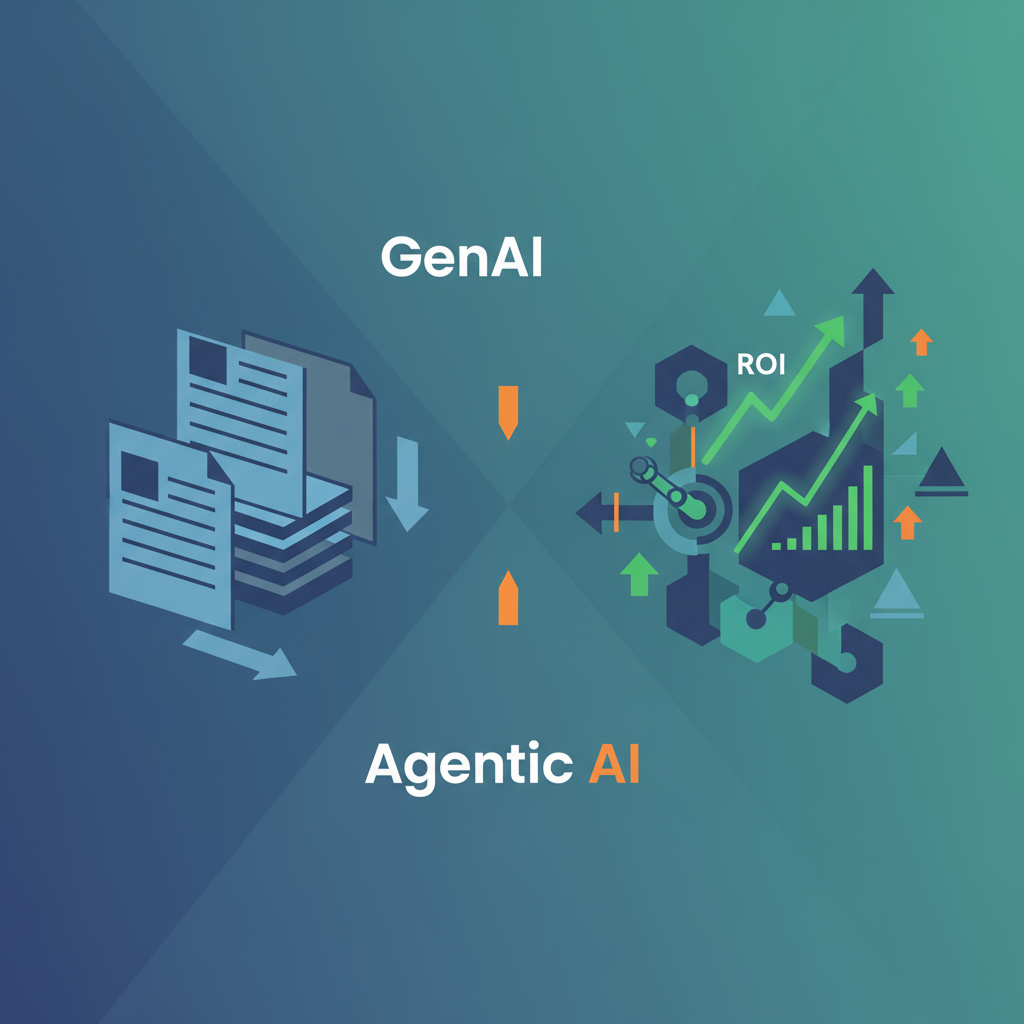
The answer lies in the type of AI being deployed. Most GenAI tools generate content but stop short of executing tasks. Whilst a generative model might draft a variance report, the heavy lifting and manual action still falls to analysts.
Autonomous Execution Drives ROI
Agentic AI takes a fundamentally different approach by working autonomously. Rather than producing drafts requiring manual follow-through, agentic systems take action. An agentic system can run analysis itself, reconcile numbers across multiple systems, and share results with decision-makers.
This shift from passive analysis to proactive resolution delivers ROI through reduced cycle times and lower error rates. Organisations piloting agentic AI report faster reporting cycles, reduced compliance costs, and significant productivity improvements.
For example, automating reconciliation to save 25% of time or shortening customer onboarding from two weeks to two days produces clear, measurable value—precisely what executives demand after years of GenAI promises.
Trust Through Transparency
Execution alone isn’t sufficient. Trust remains one of the largest barriers to AI adoption. Thomson Reuters reports that 70% of firms using GenAI lack responsible-use policies, and 72% offer no AI-specific training.
Agentic AI addresses this through transparency mechanisms: audit logs, role-based access, and data lineage tracking that show what was done, by whom, and why. This accountability builds user confidence whilst reducing reputational and compliance risk.
Integration Over Fragmentation
The rush to adopt AI has left many companies with ecosystems of disconnected tools. A survey of over 1,000 IT and security professionals found that nearly half cite overlapping tools as a major challenge.
Agentic AI offers an alternative path by acting as connective tissue across existing platforms, linking CRMs, ERP software, HR, and collaboration tools without adding system fragility. This consolidates value creation into fewer, more capable systems.
Continuous Execution
Most AI tools are designed for one-time tasks. But enterprise work is a process, not a single task. Agentic systems run continuously in the background, detecting when action is needed and triggering the next best course without requiring users to log in or confirm.
McKinsey’s 2024 State of AI report found that top-performing AI adopters were 2.1 times more likely to embed AI into daily workflows compared to peers. Agentic systems achieve this by turning intent into execution—delivering business value where traditional generative tools fall short.
Source: TechRadar