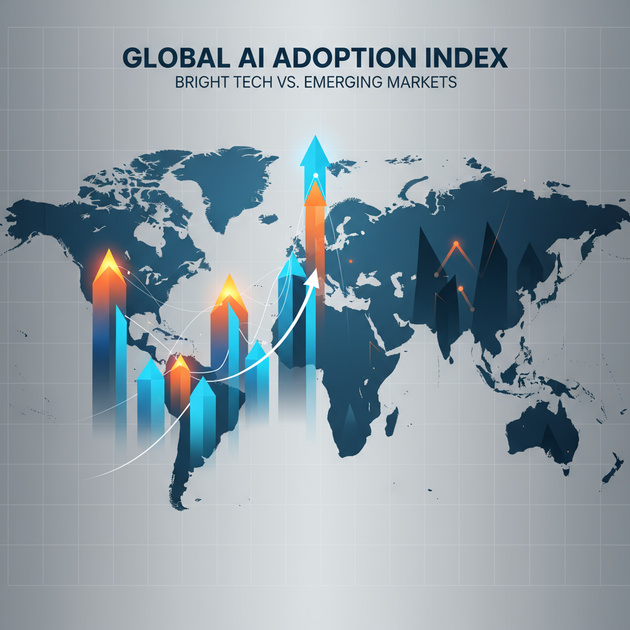
The AI concentration trap: Why early adoption patterns threaten global economic equality
Key Finding: AI adoption is following a predictable but accelerated pattern of geographic and economic concentration that could entrench existing inequalities rather than democratise technological benefits.
Anthropic’s latest Economic Index reveals a sobering reality: despite AI’s promise to democratise intelligence, early adoption patterns mirror the concentration dynamics that created today’s digital divides. With 40% of US employees using AI at work—a doubling in just two years—the speed is unprecedented, but the distribution patterns are disturbingly familiar.
The data exposes three critical strategic realities that leaders must confront: geographic concentration that favours already-prosperous regions, enterprise automation that’s reshaping work faster than workers can adapt, and a widening capability gap between those with access to contextual data and those without.
Strategic Context
The Real Story Behind the Headlines
Whilst headlines celebrate AI’s rapid adoption—reaching in two years what the internet took five to achieve—the underlying distribution reveals a more complex reality. Singapore leads per-capita Claude usage at 4.6x its population share, whilst Nigeria operates at just 0.2x. This isn’t merely a development gap; it’s a structural divergence that could reshape global economic hierarchies.
The pattern extends beyond national boundaries. Within the US, Washington DC and Utah outpace California in per-capita usage, suggesting that local economic structures—not just proximity to Silicon Valley—determine adoption success.
Critical Numbers That Matter
| Metric | Finding | Strategic Implication |
|---|---|---|
| 77% enterprise automation | Businesses delegate complete tasks vs. 50% for individuals | Work displacement accelerating faster than workforce adaptation |
| 36% coding dominance | Programming tasks lead all usage categories | Technical skills becoming gateway to AI productivity gains |
| 0.7% GDP correlation | Each 1% income increase = 0.7% more AI usage | Economic advantages compound exponentially |
| 39% directive usage | Up from 27% in late 2024 | Users increasingly trusting AI with complete task ownership |
Deep Dive Analysis
What’s Really Happening
The data reveals AI adoption following a three-stage concentration pattern: initial clustering in high-capability regions, task specialisation around programmable workflows, and progressive automation of complex processes. This creates a compounding advantage cycle where early adopters gain access to more sophisticated applications, widening the capability gap.
Critical Insight: Unlike previous technologies that eventually democratised, AI’s requirement for contextual data and technical integration may create permanent structural advantages for well-resourced organisations and regions.
Success Factors Often Overlooked
- Contextual data accessibility: Complex AI deployment requires extensive input data—a barrier favouring organisations with existing digital infrastructure
- Local economic structure alignment: Regions with knowledge-worker concentrations show dramatically higher adoption rates
- Cultural automation acceptance: High-adoption countries show greater willingness to delegate complete tasks to AI systems
- Technical integration capability: Success correlates with ability to embed AI into existing workflows, not just access to tools
The Implementation Reality
The report’s most striking finding challenges assumptions about AI democratisation. Whilst individual users increasingly collaborate with AI (augmentation), enterprise deployment overwhelmingly focuses on complete task delegation (automation). This split suggests two parallel AI economies emerging: a human-AI partnership model for creative work and a full automation model for systematic business processes.
⚠️ Warning: This divergence could create a two-tier labour market where workers capable of AI collaboration command premium wages whilst those in automatable roles face displacement without alternatives.
Strategic Analysis
Beyond the Technology: The Human Factor
The geographic concentration isn’t merely about infrastructure—it reflects deeper structural factors. Countries leading in AI adoption share characteristics beyond wealth: robust digital ecosystems, knowledge-worker economies, and cultural comfort with automation. These factors create network effects that compound advantages over time.
Stakeholder Impact Analysis:
| Stakeholder | Impact | Support Needed | Success Metrics |
|---|---|---|---|
| Developed economies | Accelerated productivity gains | Investment in AI integration | GDP per capita growth, innovation indices |
| Emerging markets | Risk of technological leapfrogging failure | Infrastructure development, skills training | Adoption rate convergence, local capability building |
| Knowledge workers | Enhanced productivity through AI partnership | Continuous learning, tool adaptation | Output quality improvement, role evolution |
| Routine workers | Potential displacement through automation | Reskilling programmes, transition support | Employment stability, skills transfer success |
What Actually Drives Success
The research reveals three critical success factors that transcend simple technology access:
- Contextual data orchestration: Organisations succeeding with complex AI deployment provide extensive input context—often requiring fundamental data infrastructure changes
- Economic structure alignment: Success correlates strongly with existing knowledge-work concentration, suggesting AI amplifies rather than transforms economic foundations
- Automation acceptance: Regions showing higher AI adoption demonstrate greater comfort with delegating complete tasks, not just seeking AI assistance
💡 Success Redefinition: AI adoption success should be measured not by usage rates alone, but by the breadth of economic sectors engaged and the inclusivity of access across different worker categories.
Strategic Recommendations
🎯 Implementation Framework:
- Phase 1: Infrastructure assessment and contextual data preparation
- Phase 2: Pilot automation in high-value, low-risk processes
- Phase 3: Scale based on demonstrable ROI and workforce adaptation capacity
Priority Actions for Different Contexts
For Organisations Just Starting:
- Audit existing data infrastructure to identify AI-ready processes
- Focus initial deployment on tasks with clear input-output relationships
- Establish workforce communication about AI integration rather than replacement
For Organisations Already Underway:
- Analyse automation vs. augmentation balance to ensure sustainable workforce transition
- Invest in contextual data systems to enable more sophisticated AI deployment
- Monitor competitive positioning relative to regional adoption patterns
For Advanced Implementations:
- Address automation bias by deliberately preserving human expertise development
- Build capability-sharing programmes to support broader ecosystem development
- Develop frameworks for ethical automation that considers societal impact
Hidden Challenges
Challenge 1: The contextual data bottleneck Complex AI deployment requires extensive input context, favouring organisations with existing data infrastructure whilst creating barriers for others. Mitigation Strategy: Invest in data modernisation as an AI-enablement initiative, not just a compliance requirement.
Challenge 2: Geographic amplification effects Current patterns suggest AI will amplify existing economic advantages rather than democratise opportunities across regions. Mitigation Strategy: Develop deliberate inclusion strategies and cross-regional knowledge transfer programmes.
Challenge 3: Automation acceleration gap Enterprise automation (77%) vastly outpaces individual adaptation, potentially creating workforce displacement faster than retraining capacity. Mitigation Strategy: Implement graduated automation with mandatory workforce transition support.
Challenge 4: The collaboration skills divide High-adoption regions show more collaborative AI usage whilst emerging markets focus on automation, potentially creating different AI fluency levels. Mitigation Strategy: Prioritise augmentation training alongside automation deployment to preserve human capability development.
Strategic Takeaway
The AI revolution isn’t delivering the democratised intelligence many predicted. Instead, it’s following predictable concentration patterns that risk entrenching existing inequalities on an accelerated timeline.
Three Critical Success Factors
- Contextual infrastructure preparation: Success requires extensive data accessibility, not just AI tool access
- Balanced automation strategy: Organisations must consciously manage automation vs. augmentation to maintain workforce adaptability
- Inclusive adoption planning: Leaders must address concentration effects proactively rather than assuming technology will self-democratise
Reframing Success
True AI adoption success isn’t measured by usage rates or automation percentages, but by whether implementation strengthens rather than fragments economic opportunity across geographic and social boundaries.
Key Strategic Insight: The window for shaping inclusive AI adoption patterns is narrowing rapidly. Current concentration trends could lock in structural advantages that persist for decades, making proactive intervention essential.
Your Next Steps
Immediate Actions (This Week):
- Assess your organisation’s position within regional AI adoption patterns
- Audit contextual data accessibility for priority business processes
- Evaluate current automation vs. augmentation balance in AI initiatives
Strategic Priorities (This Quarter):
- Develop workforce transition planning alongside AI deployment roadmaps
- Establish partnerships with emerging market organisations to prevent capability isolation
- Create measurement frameworks that prioritise inclusive impact alongside efficiency gains
Long-term Considerations (This Year):
- Build cross-regional AI capability sharing programmes
- Invest in data infrastructure that enables sophisticated AI without excluding participation
- Advocate for policies that promote AI access equity rather than pure adoption speed
Source: Anthropic Economic Index report: Uneven geographic and enterprise AI adoption
This strategic analysis was developed by Resultsense, providing AI expertise by real people. We help organisations navigate the complexity of AI implementation with practical, human-centred strategies that deliver real business value.