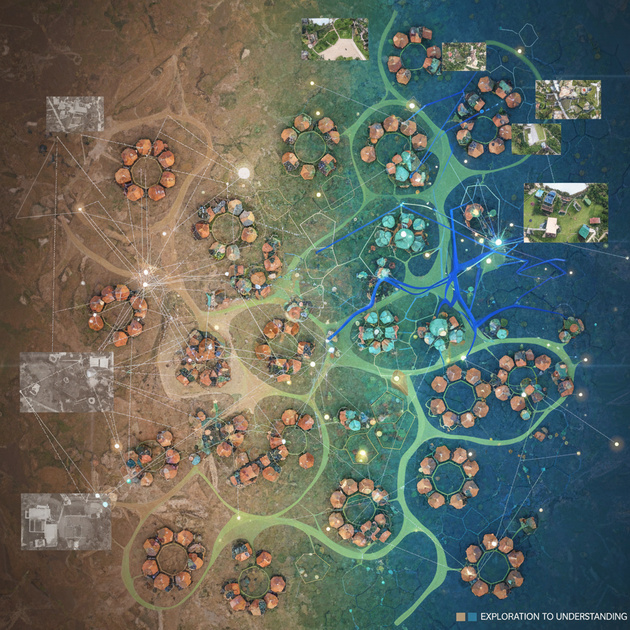
Opening Hook 🎯
UNHCR’s AI-powered refugee settlement mapping transformed urban planning from “guesswork” to data-driven decision making for over 300,000 refugees across 20+ countries—demonstrating how collaborative AI implementation can deliver measurable impact at unprecedented scale.
Critical Insight: The success wasn’t in the technology itself, but in the collaborative framework that connected refugees providing ground-level data, humanitarian workers defining requirements, and developers building scalable solutions.
This case study reveals how organisations can achieve rapid AI deployment through strategic partnerships, open-source collaboration, and human-centred implementation—bypassing common enterprise complexity whilst delivering enterprise-scale results.
Strategic Context 📊
Traditional humanitarian mapping required manual surveys taking years to complete, leaving aid organisations operating on outdated assumptions whilst refugee populations faced inadequate resource allocation based on incomplete data.
The Real Story Behind the Headlines
UNHCR’s breakthrough wasn’t just technological—it was organisational. By creating a collaborative framework that valued refugee knowledge as strategic data input, they transformed the entire operational model from reactive crisis management to proactive resource planning.
Critical Numbers Table
| Metric | Traditional Approach | AI-Powered Approach | Strategic Implication |
|---|---|---|---|
| Settlement Mapping Time | Years | Weeks | 95% faster strategic planning |
| Population Covered | Limited sampling | 300,000+ refugees | Complete operational visibility |
| Countries Benefiting | Pilot locations only | 20+ nations | Scalable global framework |
| Data Sources | External surveys only | Refugee-generated imagery + ML | Community-driven intelligence |
Deep Dive Analysis 🔍
What’s Really Happening
UNHCR didn’t just implement AI—they orchestrated a multi-stakeholder ecosystem where refugees became data contributors, humanitarian workers became requirement definers, and developers became solution architects. This collaborative model eliminated traditional implementation barriers whilst accelerating deployment timelines.
Critical Insight: Success came from treating AI as an orchestration tool rather than a replacement technology, maintaining human decision-making authority whilst amplifying data processing capabilities.
Success Factors Often Overlooked
- Community Integration: Refugees provided drone imagery and ground-truth validation, ensuring cultural context and operational accuracy
- Open Source Strategy: Publishing datasets, models, and code created immediate scalability and continuous improvement opportunities
- Iterative Learning: Manual annotation training informed machine learning models, creating a feedback loop between human expertise and algorithmic capability
- Cross-Sector Collaboration: Microsoft AI for Good Lab, Humanitarian OpenStreetMap Team, and GitHub provided complementary capabilities without territorial conflicts
The Implementation Reality
Traditional enterprise AI projects fail at the integration stage—this succeeded because it was designed as an integration-first initiative. Rather than building isolated AI capabilities, they created an ecosystem where each participant’s unique value was amplified through AI-powered coordination.
⚠️ Major Risk Alert: Many organisations attempt to replicate this approach without establishing the collaborative governance framework first, leading to data quality issues, stakeholder misalignment, and failed adoption despite technical success.
Strategic Analysis 💡
Beyond the Technology: The Human Factor
UNHCR’s approach demonstrates that AI implementation success depends more on organisational design than technological sophistication. By positioning refugees as data contributors rather than passive recipients, they created sustainable engagement and continuous data improvement.
Stakeholder Impact Table
| Stakeholder Group | Impact | Support Needed | Success Metrics |
|---|---|---|---|
| Refugees | Empowerment through data contribution | Training on drone operation and image capture | Community adoption rates, data quality scores |
| Humanitarian Workers | Evidence-based decision making | AI literacy and interpretation training | Planning cycle reduction, resource allocation accuracy |
| Developers | Purpose-driven technical challenges | Domain expertise and feedback loops | Code quality, deployment speed, system reliability |
| Aid Recipients | Improved service delivery | Transparent communication about data usage | Service quality improvements, response time reductions |
What Actually Drives Success
Success redefinition is crucial: UNHCR measured impact not just by technical metrics (model accuracy, processing speed) but by operational outcomes (planning cycle time, resource allocation accuracy, community engagement levels). This dual-metric approach ensured technical capability translated into organisational value.
🎯 Success Redefinition: Technical metrics validated capability; operational metrics validated value. Both were required for sustained investment and stakeholder buy-in.
Strategic Recommendations 🚀
💡 Implementation Framework: Phase 1: Establish collaborative governance (stakeholder mapping, data sharing agreements, success metrics alignment) Phase 2: Pilot with controlled scope (single use case, limited participants, rapid iteration cycles) Phase 3: Scale through ecosystem expansion (additional use cases, broader participation, systematic knowledge sharing)
Priority Actions for Different Contexts
For Organisations Just Starting
- Map Your Ecosystem: Identify all stakeholders who contribute data, define requirements, or consume outputs
- Design Collaboration First: Establish governance frameworks before selecting technology solutions
- Start with Manual Processes: Use human expertise to define quality standards before automating
For Organisations Already Underway
- Open Your Data Pipeline: Create transparency in data sources, processing methods, and output validation
- Expand Stakeholder Engagement: Include end-users as active contributors rather than passive recipients
- Implement Dual Metrics: Track both technical performance and operational impact consistently
For Advanced Implementations
- Scale Through Partnerships: Create ecosystem value by sharing capabilities and learnings with complementary organisations
- Automate Governance: Build systematic feedback loops that improve processes without human intervention
- Measure Second-Order Effects: Track how AI implementation changes organisational culture and decision-making quality
Hidden Challenges ⚠️
Challenge 1: Data Quality Governance Ground-truth validation becomes complex when data contributors lack technical training. UNHCR addressed this through structured training programmes and iterative quality feedback. Mitigation Strategy: Invest in contributor training and create automated quality checks that provide immediate feedback without penalising learning curves.
Challenge 2: Stakeholder Coordination Overhead Managing multiple organisations with different priorities, timelines, and technical capabilities creates significant coordination costs. Mitigation Strategy: Establish clear governance structures with defined decision-making authority and regular alignment checkpoints before technical implementation begins.
Challenge 3: Sustainability Without Continued Innovation Open-source projects risk abandonment when initial enthusiasm wanes or key contributors move on. Mitigation Strategy: Create institutional ownership structures and document knowledge transfer procedures as part of initial implementation rather than post-deployment maintenance.
Challenge 4: Cultural Resistance to Data Sharing Organisations may resist sharing proprietary data or methods, limiting ecosystem benefits even when technical integration is successful. Mitigation Strategy: Design value-sharing mechanisms that reward data contribution and create competitive advantage through participation rather than exclusion.
Strategic Takeaway 🎯
UNHCR’s AI refugee mapping project succeeded because it prioritised collaborative governance over technological sophistication, creating an ecosystem where each participant’s unique value was amplified through AI-powered coordination rather than replaced by automation.
Three Critical Success Factors
- Collaborative Design: Success required treating AI as an orchestration technology that amplifies human expertise rather than replacing human decision-making
- Dual-Metric Validation: Technical capability metrics validated feasibility; operational impact metrics validated value and sustained investment
- Ecosystem Value Creation: Open-source sharing and cross-sector partnerships created scalability and continuous improvement that no single organisation could achieve independently
Reframing Success
Traditional AI ROI focuses on cost reduction and efficiency gains. UNHCR’s approach demonstrates that the highest-value AI implementations create new capabilities and collaborative structures that generate value impossible to achieve through traditional methods.
Key Strategic Insight: The most transformative AI implementations don’t just improve existing processes—they enable entirely new organisational models and value-creation mechanisms that compound over time.
Your Next Steps
Immediate Actions (This Week)
- Stakeholder Audit: Map all parties who contribute data, define requirements, or consume AI outputs in your current or planned implementations
- Governance Gap Analysis: Identify where collaboration breaks down between technical teams and domain experts
- Success Metrics Review: Define operational impact measures alongside technical performance indicators
Strategic Priorities (This Quarter)
- Pilot Collaborative Framework: Test community-driven data contribution or cross-functional AI implementation on limited scope
- Open Source Assessment: Evaluate opportunities to share non-competitive capabilities or learnings with ecosystem partners
- Dual-Metric Dashboard: Implement tracking for both technical performance and organisational impact metrics
Long-term Considerations (This Year)
- Ecosystem Strategy Development: Design value-sharing mechanisms that reward collaboration whilst protecting competitive advantages
- Cultural Change Programme: Build organisational capacity for AI-human collaboration rather than AI replacement mindset
- Knowledge Transfer Infrastructure: Create systematic documentation and training programmes that sustain AI capabilities beyond individual contributors
Source: Using AI to map hope for refugees with UNHCR, the UN Refugee Agency
This strategic analysis was developed by Resultsense, providing AI expertise by real people.