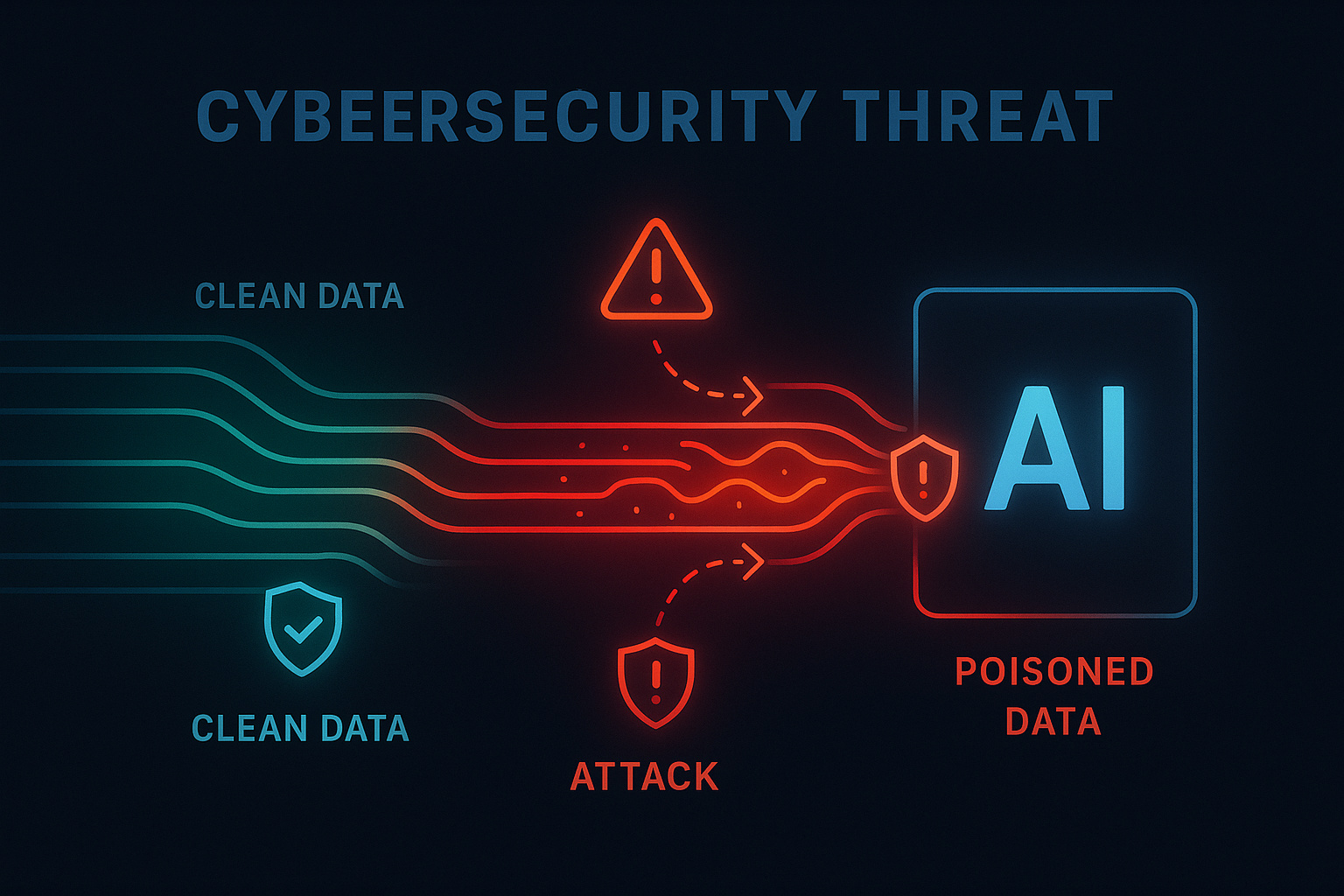
250 poisoned documents. That’s the surprisingly consistent number required to compromise large language models, regardless of whether you’re running a 600 million parameter model or a 13 billion parameter enterprise system. New research from Alexandra Souly, Nicholas Carlini, and colleagues fundamentally challenges the assumption that larger, more sophisticated AI models offer inherently better security postures.
The attack surface for data poisoning in LLMs remains constant across model scales—a near-fixed vulnerability that doesn’t diminish with computational power or training data volume.
For organisations deploying or planning LLM implementations, this finding carries profound implications: your security strategy cannot rely on model sophistication alone. The fundamental vulnerability persists regardless of whether you’re using cutting-edge foundation models or more modest deployments, shifting the security conversation from “which model?” to “how do we protect any model?”
The Security Assumption That No Longer Holds
The enterprise AI security model has operated on a comforting assumption: bigger models trained on larger datasets should be more resilient to manipulation. More parameters, more training data, more computational resources—surely these factors create stronger defences against malicious inputs.
The research systematically dismantles this assumption. Testing across models from 600 million to 13 billion parameters, trained on datasets ranging from 6 billion to 260 billion tokens, reveals a stark pattern: the poisoning threshold remains stubbornly consistent. Whether you’re running a modest deployment or enterprise-scale infrastructure, attackers need roughly the same number of carefully crafted documents to compromise your system.
Critical Numbers: What the Research Actually Reveals
| Model Parameter Range | Training Dataset Size | Poisoning Documents Required | Security Implication |
|---|---|---|---|
| 600M to 13B parameters | 6B to 260B tokens | ~250 documents | Constant attack surface regardless of scale |
| All tested configurations | Various distribution patterns | Consistent vulnerability | Traditional scaling defences ineffective |
| Enterprise deployments | Production-scale data | Near-fixed threshold | Security requires fundamental rethinking |
The Real Story Behind the Headlines
This isn’t about a specific vulnerability in particular models—it’s about a fundamental property of how LLMs learn from training data. The consistency of the poisoning threshold across wildly different model architectures and training regimes suggests we’re observing an inherent characteristic of the technology itself, not a correctable flaw in implementation.
The research examined multiple scenarios: pretraining poisoning, fine-tuning attacks, and various distributions of malicious documents within training data. The pattern holds across all conditions. This consistency is precisely what makes the finding strategically significant—there’s no simple technical fix on the horizon.
Why This Changes Enterprise AI Planning
Traditional cybersecurity scales with infrastructure investment. Better firewalls, more sophisticated intrusion detection, larger security teams—these investments typically yield proportional risk reduction. LLM security, it appears, doesn’t follow this comforting pattern.
What’s Really Happening at the Operational Level
Organisations deploying LLMs face a security landscape where:
Training Data Becomes Attack Surface: Every external data source feeding your LLM training pipeline—industry documents, customer interactions, publicly sourced content—represents potential injection points. The research demonstrates that attackers don’t need to compromise vast quantities; 250 strategically placed documents suffice.
CRITICAL INSIGHT: Your LLM security posture is fundamentally limited by your weakest data ingestion point, not your strongest model architecture.
Scale Doesn’t Provide Security: Moving from smaller proof-of-concept deployments to enterprise-scale implementations doesn’t inherently reduce vulnerability. The £500,000 investment in computational infrastructure provides no security advantage over the £50,000 pilot when facing data poisoning attacks.
Detection Becomes Paramount: Traditional defences focused on input filtering and output monitoring remain necessary but insufficient. The constant attack threshold means organisations require robust data provenance tracking and anomaly detection throughout the training pipeline.
Success Factors Often Overlooked
- Data Source Authentication: Verifying the integrity and origin of every training data source, not just sanitising content
- Continuous Monitoring: Real-time analysis of model behaviour changes during training, not just post-deployment testing
- Segregated Training Pipelines: Isolating different data sources to contain potential compromises
- Human Oversight at Scale: Systematic review processes that don’t rely solely on automated checks
The Implementation Reality Most Documentation Ignores
Enterprises implementing LLMs typically focus security efforts on deployment: input validation, prompt injection prevention, and output filtering. The research suggests this approach is backwards. The critical security work happens during training, where data poisoning can embed vulnerabilities that survive all deployment-level protections.
⚠️ WARNING: Standard deployment security measures cannot remediate training-level compromises. Data poisoning creates model-level vulnerabilities that persist regardless of runtime protections.
Beyond Technology: Organisational Security Implications
The constant attack surface finding forces a fundamental rethinking of AI security responsibilities and organisational structures. This isn’t merely a technical challenge for IT security teams—it’s a strategic governance issue requiring board-level attention.
The Human Factor No One’s Addressing
Security theatrics often focus on sophisticated technical controls whilst ignoring the organisational realities that actually determine security outcomes. The constant poisoning threshold means every team member who contributes to training data selection becomes a security stakeholder, whether they recognise this responsibility or not.
Marketing teams sourcing industry content for training data aren’t traditionally security-conscious. Operations personnel selecting customer interaction logs for fine-tuning lack security training. Executives approving data acquisition partnerships may not understand the security implications. The technology’s security characteristics demand organisational changes that few enterprises have implemented.
Stakeholder Impact Analysis
| Stakeholder Group | Security Impact | Required Support | Success Metrics |
|---|---|---|---|
| Data Science Teams | Expanded responsibility for data provenance verification | Security training, provenance tools | Verified data source documentation |
| Security Teams | Shift from perimeter defence to pipeline monitoring | Training data analysis capabilities | Anomaly detection coverage |
| Business Units | Data selection becomes security-critical | Clear policies, approval workflows | Documented data source decisions |
| Leadership | Governance framework development and enforcement | Risk assessment frameworks | Policy compliance rates |
What Actually Drives Security Success
Technical capabilities matter, but the research findings suggest that organisational factors determine practical security outcomes:
Clear Accountability Structures: Who verifies data source integrity? Who approves new training data? Who monitors for behaviour anomalies? Without explicit ownership, these critical functions don’t happen reliably.
Cross-Functional Security Culture: LLM security cannot reside solely within IT or security teams. Data science, operations, marketing, and business units all contribute to training data selection and must understand their security roles.
Continuous Verification Processes: One-time security reviews during initial deployment are insufficient. Ongoing monitoring, regular audits, and systematic verification must become standard operational practice.
🎯 REDEFINING SUCCESS: Effective LLM security isn’t measured by sophisticated technical controls but by consistent execution of verification processes across all training data sources.
Strategic Security Framework for Constant Vulnerability
Organisations cannot eliminate the 250-document vulnerability—it’s a fundamental property of current LLM technology. Strategic security planning must therefore focus on detection, containment, and rapid response rather than prevention alone.
💡 IMPLEMENTATION FRAMEWORK:
Phase 1: Data Provenance (Weeks 1-4) Establish comprehensive tracking for all training data sources, implement verification workflows, and create audit trails.
Phase 2: Continuous Monitoring (Weeks 5-8) Deploy anomaly detection for model behaviour changes, implement automated alerts, and establish investigation protocols.
Phase 3: Response Capability (Weeks 9-12) Develop containment procedures, create rollback mechanisms, and train response teams for rapid intervention.
Priority Actions for Different Organisational Contexts
For Organisations Just Starting LLM Deployments:
- Implement data source authentication and verification before beginning training
- Establish clear ownership for training data security across all contributing teams
- Deploy behaviour monitoring from day one, not as a later enhancement
For Organisations Already Deploying LLMs:
- Audit existing training data sources for provenance documentation gaps
- Implement continuous monitoring for behaviour changes indicating potential compromise
- Develop rapid response protocols for suspected data poisoning incidents
For Advanced LLM Implementations:
- Segregate training pipelines by data source sensitivity to contain potential compromises
- Build automated systems for ongoing data source reputation assessment
- Establish red team exercises specifically targeting training data manipulation
The Hidden Challenges No Vendor Discusses
The constant poisoning threshold creates security challenges that standard enterprise AI vendors rarely acknowledge in their marketing materials or even technical documentation.
Challenge 1: The Third-Party Data Dilemma
Most enterprise LLM implementations rely heavily on external data sources: industry databases, partner data feeds, publicly available content, and commercial training datasets. Each source represents potential compromise, yet organisations typically lack visibility into these sources’ security practices.
Mitigation Strategy: Implement a “zero-trust data sourcing” model where all external training data undergoes independent verification regardless of source reputation. Establish contractual security requirements with data providers that specifically address poisoning risks. Consider synthetic data generation for high-risk application areas where external data dependencies can be reduced.
Challenge 2: The Fine-Tuning Blind Spot
Organisations often treat fine-tuning as lower-risk than initial training, applying less rigorous security controls. The research demonstrates this assumption is dangerous—fine-tuning with poisoned data can compromise even securely trained foundation models.
Mitigation Strategy: Apply identical security standards to fine-tuning data regardless of foundation model pedigree. Implement behaviour monitoring that specifically tracks changes during fine-tuning phases. Maintain rollback capabilities that allow rapid reversion if fine-tuning introduces suspicious behaviour changes.
Challenge 3: The Scale-Security Misconception
Enterprise procurement often assumes that premium, large-scale models from reputable vendors provide inherent security advantages. The constant attack surface finding undermines this assumption—model sophistication doesn’t reduce vulnerability.
Mitigation Strategy: Evaluate LLM vendors based on their data provenance practices and security verification capabilities, not just model performance metrics. Require transparent documentation of training data sources and security controls. Consider smaller, more rigorously secured models over larger deployments with opaque training practices.
Challenge 4: The Continuous Deployment Problem
Modern LLM operations involve continuous retraining and fine-tuning to maintain performance and incorporate new information. This operational model creates ongoing security risk that traditional “secure once, deploy many times” approaches cannot address.
Mitigation Strategy: Build security verification into automated deployment pipelines rather than treating it as a separate gate. Implement automated behaviour regression testing that runs with every model update. Establish security baselines that new model versions must demonstrate compliance with before production deployment.
Practical Security Implications for Enterprise Deployment
The research findings demand immediate reconsideration of LLM security strategies across all deployment contexts—proof of concept, production pilots, and scaled implementations.
Core Value Proposition: Security Through Verification, Not Scale
Enterprise LLM security requires fundamentally different thinking from traditional application security. You cannot “harden” your way to safety through larger models or more sophisticated architectures. Security emerges from rigorous verification of training data provenance, continuous monitoring of model behaviour, and rapid response capabilities when anomalies emerge.
The constant 250-document threshold means that every organisation faces similar risk levels regardless of deployment scale. This democratises the security challenge—small implementations and enterprise deployments require comparable security rigour. Paradoxically, this may advantage smaller organisations that can implement tighter controls over limited data sources compared to large enterprises struggling to verify sprawling data acquisition processes.
Three Critical Success Factors
-
Data Provenance Before Performance: Prioritise training data source verification over model performance optimisation. An accurate but slightly less capable model built on verified data offers better risk-adjusted value than a sophisticated model trained on unverified sources.
-
Continuous Verification, Not Point-in-Time Assessment: LLM security is not a deployment gate to pass once. Implement ongoing monitoring, regular audits, and systematic reverification of data sources as standard operational practice.
-
Cross-Functional Security Ownership: Technical security teams cannot secure LLM implementations alone. Data selection, source verification, and anomaly detection require collaboration across data science, operations, security, and business units.
Reframing Success: When Good Enough Beats Perfect
Traditional security frameworks aim for elimination of vulnerabilities. LLM security with constant attack surfaces requires a different success definition: rapid detection and effective containment of compromises that you cannot completely prevent.
KEY STRATEGIC INSIGHT: Your LLM security posture is ultimately determined by detection speed and response capability, not by prevention measures alone. Invest accordingly.
Your Next Steps: A Pragmatic Security Roadmap
Immediate Actions (This Week):
- Audit current training data sources and document provenance gaps
- Establish clear ownership for training data security across contributing teams
- Implement basic behaviour monitoring for deployed models to establish baseline patterns
Strategic Priorities (This Quarter):
- Develop comprehensive data source verification protocols with explicit approval workflows
- Deploy automated anomaly detection for model behaviour changes during training and fine-tuning
- Create response protocols for suspected data poisoning incidents including rollback procedures
Long-term Considerations (This Year):
- Build or acquire advanced data provenance tracking capabilities across entire LLM pipeline
- Establish red team programmes specifically targeting training data manipulation
- Develop organisational capability for rapid model retraining from verified data sources
Source: Poisoning Attacks on LLMs Require a Near-constant Number of Poison Samples
This strategic analysis was developed by Resultsense, providing AI expertise by real people.