Introduction
When Professor Andrew Ng, a leading AI researcher, states that 80% of AI work involves data preparation, he’s highlighting a critical truth that many UK businesses overlook. The foundation of successful AI implementation isn’t sophisticated algorithms or cutting-edge technology—it’s the quality and readiness of your data.
The stakes are high. Research shows that 36% of UK AI projects fail due to inadequate data preparation, whilst Gartner predicts that 30% of generative AI projects will be abandoned by the end of 2025 due to poor data quality alone. These aren’t just statistics—they represent millions of pounds in wasted investment and lost opportunities for British businesses.
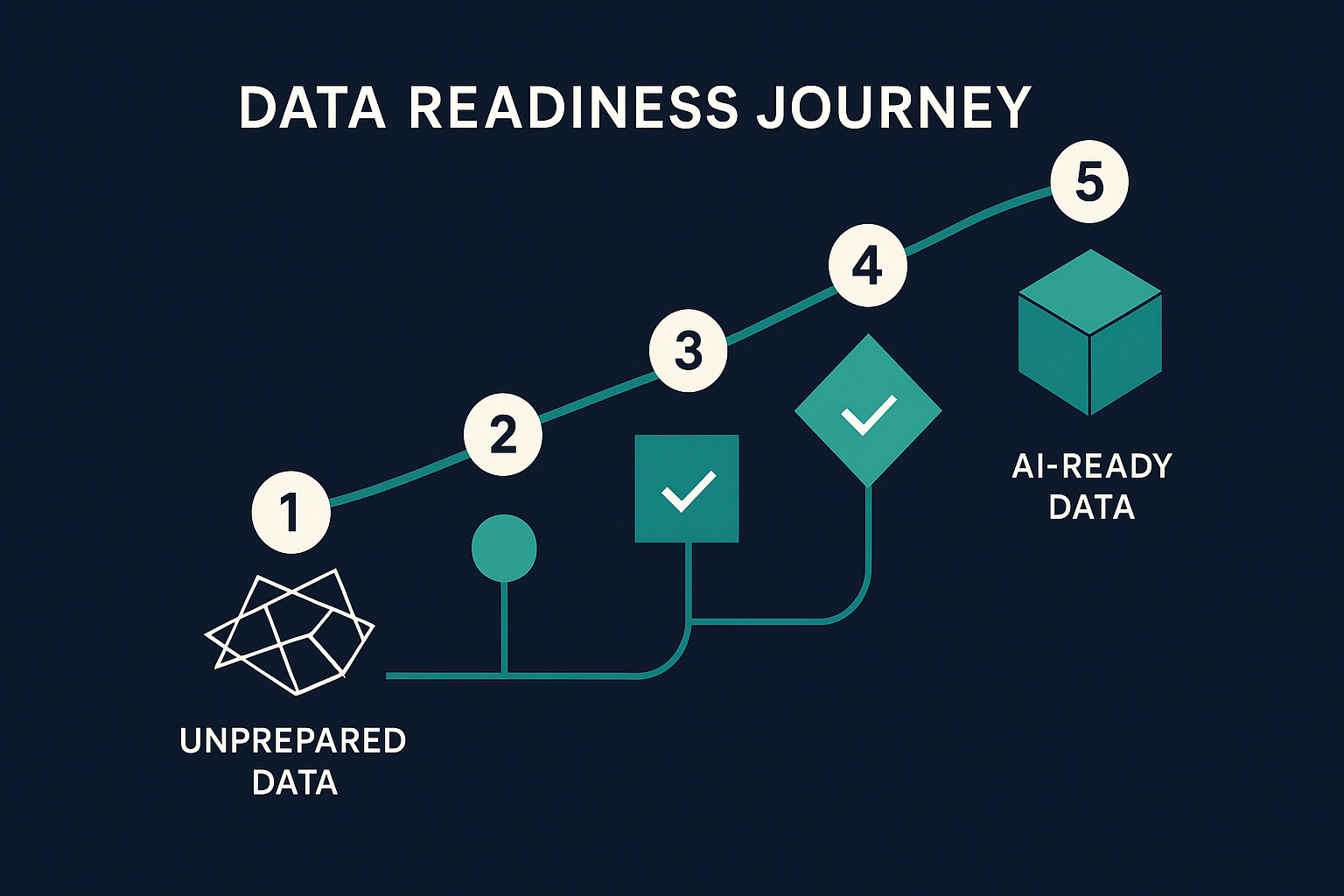
Data readiness AI implementation is the cornerstone of success. This guide presents a practical 5-step framework that UK SMEs can follow to ensure their data is prepared, organised, and fit for purpose before investing in AI solutions. Whether you’re just beginning your AI journey or looking to understand why previous initiatives haven’t delivered, this framework will help you build the solid foundation necessary for AI success.
Why Data Readiness Matters for UK SMEs
The opportunity cost of neglecting data preparation is staggering. Currently, 43% of UK SMEs have no AI adoption plans, contributing to an estimated £94 billion in unrealised GDP growth. Only 15% of small UK businesses currently use AI, leaving the vast majority at risk of falling behind competitors who are already leveraging these technologies to drive efficiency and innovation.
However, rushing into AI without proper data preparation is equally risky. As Professor Andrew Ng emphasises: “If 80 percent of our work is data preparation, then ensuring data quality is the most critical task.” This isn’t academic theory—it’s practical business reality. Your AI system can only be as good as the data you feed it, and poor data quality leads to unreliable insights, flawed decisions, and ultimately, failed projects.
The competitive advantage lies not in implementing AI first, but in implementing it properly. SMEs that invest time in data readiness see tangible business outcomes: improved operational efficiency, reduced costs through automation, faster and more accurate decision-making, and enhanced customer experiences. Meanwhile, those who skip this crucial foundation stage often find themselves abandoning expensive AI projects within months, having learned an expensive lesson about the importance of data preparation.
The message is clear: for UK SMEs looking to compete in an increasingly AI-driven marketplace, proper data preparation isn’t optional—it’s essential for survival and growth.
The 5-Step Data Readiness Framework
Step 1: Data Strategy & Goal Setting
Before touching any data or evaluating any AI tools, you need clarity on what you’re trying to achieve. This means moving beyond vague aspirations like “we want to use AI” to specific, measurable use cases aligned with your business objectives.
Start by identifying concrete problems AI could solve in your business. For a retailer, this might be inventory forecasting to reduce waste and stockouts. For a professional services firm, it could be automating initial client queries to free up expert time for complex cases. For a manufacturer, perhaps it’s predictive maintenance to minimise equipment downtime.
Define measurable KPIs for each use case. If you’re implementing customer service automation, what metrics matter? Response time reduction? Customer satisfaction scores? Cost per query? Having these benchmarks from the start allows you to measure ROI and justify continued investment.
Most importantly, ensure your data initiatives align with broader business objectives. AI for AI’s sake is a recipe for failure. Every data preparation effort should connect directly to business outcomes that matter to your bottom line.
Step 2: Data Quality Assessment
With clear goals established, it’s time to evaluate whether your existing data can support them. Assess your data across four critical dimensions:
Accuracy examines whether your data is correct and error-free. A customer database filled with typos, outdated contact details, or incorrect order histories will produce unreliable AI outputs. Review a sample of your data manually to identify systematic errors or data entry issues that need addressing.
Completeness identifies gaps and missing values. If your sales records lack customer location data, any AI system trying to identify regional trends will fail. Document which fields are consistently populated and which have significant gaps—this reveals what data collection processes need improving.
Consistency ensures data is uniform across different systems. If your e-commerce platform records customer names as “FirstName LastName” but your CRM uses “LastName, FirstName”, AI systems will struggle to match records. Standardising data formats across systems is crucial for effective data integration.
Timeliness confirms your data is current and regularly updated. Historical data has value, but AI systems making real-time decisions need fresh information. Review how often different data sources update and whether this frequency matches your use case requirements.
This assessment often reveals uncomfortable truths about data quality, but it’s far better to discover these issues now than after investing in AI tools that can’t function effectively.
Step 3: Data Integration
Most businesses don’t have all their data in one place. Customer information lives in your CRM, financial data sits in accounting software, operational metrics exist in spreadsheets, and communication history is scattered across email and messaging platforms. Effective AI readiness requires bringing this data together into a coherent whole.
Data integration starts with identifying which data sources are relevant to your AI use cases. Then establish connections between these systems, either through direct integrations provided by software vendors or through middleware tools like Zapier that can pass data between applications automatically.
Pay particular attention to API readiness—the ability for systems to communicate and share data programmatically. Modern cloud software typically offers APIs, but legacy systems might require more creative solutions or data exports at regular intervals.
Don’t overlook unstructured data. Emails, documents, and images contain valuable information but require structuring before AI can process them. This might involve extracting key fields from documents or using optical character recognition (OCR) to convert images to text.
The goal is creating a single source of truth—one authoritative place where accurate, complete data exists for each business entity, whether that’s a customer, product, or transaction.
Step 4: Data Governance
Data governance sounds bureaucratic, but it’s actually about establishing clear rules and responsibilities that prevent chaos as your data usage scales.
Start by establishing data ownership. Who is responsible for ensuring customer data stays accurate? Who decides what financial data gets retained and for how long? Without clear accountability, data quality inevitably degrades over time.
Implement security measures and access controls appropriate to your data’s sensitivity. Not everyone needs access to everything. Role-based permissions ensure employees can access data relevant to their work whilst protecting sensitive information.
GDPR compliance is non-negotiable for UK businesses. This means documenting what personal data you collect, why you collect it, how long you keep it, and how individuals can access or delete their data. AI systems must respect these same principles—they cannot use data in ways that violate your stated privacy policies.
Create clear data retention and deletion policies. How long do you keep customer records after their last purchase? When do you archive old project files? These decisions affect both storage costs and compliance obligations.
Step 5: Data Accessibility & Literacy
Even perfectly prepared data delivers no value if the right people can’t access or understand it. This final step focuses on ensuring your organisation can actually use the data you’ve carefully prepared.
Data accessibility means ensuring relevant team members can retrieve the information they need when they need it. This doesn’t mean giving everyone access to everything—it means thoughtfully designing permissions so people have what they require without being overwhelmed by irrelevant data.
Building data literacy across your team is equally important. Can your sales team interpret the customer insights your AI provides? Do your operations managers understand what your forecasting models are telling them? Invest time in training staff to read dashboards, understand basic statistics, and question data that doesn’t match their experience.
Creating a data-driven culture takes time but transforms how decisions get made. Instead of relying solely on intuition or past practice, teams begin asking “what does the data show?” before making choices. This cultural shift multiplies the value of your data readiness AI implementation investment.
Taking Action on Data Readiness
You now have a comprehensive framework for preparing your data for AI implementation. These five steps—Data Strategy & Goal Setting, Data Quality Assessment, Data Integration, Data Governance, and Data Accessibility & Literacy—provide a systematic approach that UK SMEs can follow regardless of size or sector.
The key to success is starting with clear business objectives and building a solid data foundation before investing in AI tools. By following this framework systematically, you’ll avoid the common pitfalls that cause 36% of UK AI projects to fail and position your business for successful AI adoption that delivers measurable results.
If you need guidance implementing this framework or assessing your organisation’s data readiness, contact our team for a consultation on preparing your business for AI success.