The £235k AI reality check: Why UK business investment isn’t matching innovation outcomes
🎯 The £235k Question: Why UK AI Investment Isn’t Delivering Innovation
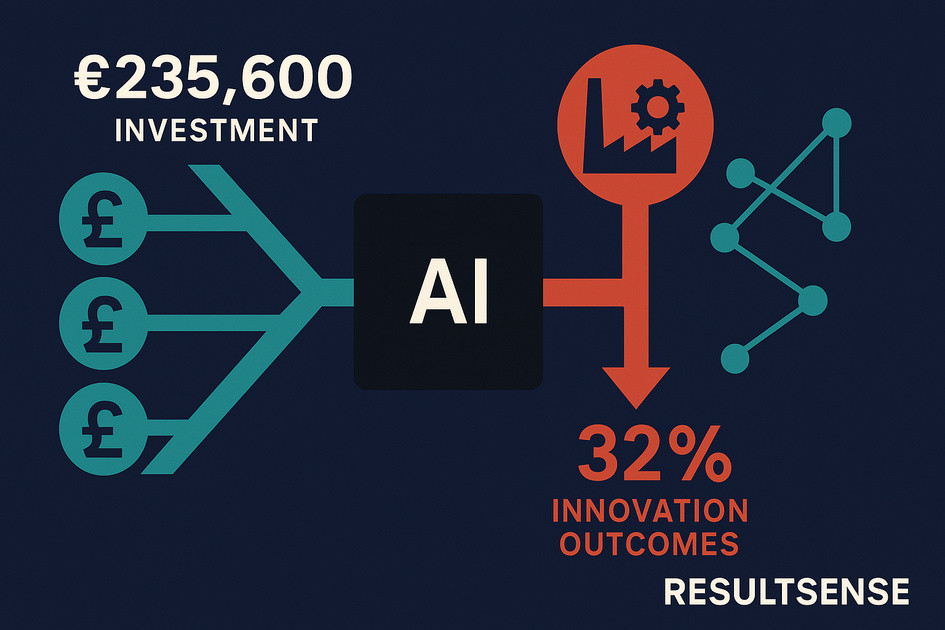
UK businesses have invested an average of £235,600 on AI technologies, yet only 32% report improved innovation outcomes. This striking disparity reveals a fundamental disconnect between AI investment enthusiasm and strategic implementation effectiveness. With 89% of UK businesses planning AI initiatives over the next two years, we’re witnessing the largest technology adoption wave since the internet—but one where financial commitment significantly outpaces operational transformation.
Key Finding: The average £235k AI investment is producing measurable innovation improvements in fewer than one-third of organisations, suggesting that spending patterns are misaligned with value creation mechanisms.
Recent analysis of over one million UK business clients reveals that whilst confidence in AI leadership potential remains high at 72%, the gap between investment scale and innovation outcomes indicates systematic implementation challenges that financial resources alone cannot resolve.
📊 The Investment-Innovation Disconnect: What the Numbers Really Mean
The UK’s AI investment landscape presents a paradox: unprecedented financial commitment coupled with modest innovation returns. This analysis examines why substantial capital deployment isn’t translating into proportional strategic advantage, and what this means for organisations navigating their AI transformation journey.
Understanding this investment-outcome gap is critical for strategic planning, as it reveals where traditional technology adoption models fail in the AI context and highlights the human-centred factors that determine success or failure.
The Real Story Behind the Headlines
Whilst media coverage focuses on the 89% adoption rate and substantial investment figures, the underlying data reveals a more complex reality. The gap between investment enthusiasm and innovation outcomes suggests that organisations are approaching AI with industrial-era thinking rather than adaptive, learning-focused strategies.
Critical Numbers That Matter:
| Metric | Reported Value | Strategic Implication |
|---|---|---|
| Average Investment | £235,600 | High financial commitment indicating serious intent |
| Innovation Improvement | 32% | Less than one-third achieving core strategic objective |
| Decision-Making Enhancement | 31% | Marginal improvement despite substantial investment |
| Investment Confidence Gap | 68% vs 32% | Planned investment far exceeds current success rate |
🔍 Deep Dive: The Investment-Innovation Paradox
The most striking finding isn’t the scale of AI investment, but the disproportionately modest innovation outcomes relative to financial commitment. This suggests fundamental misconceptions about how AI creates value within organisational contexts.
Critical Insight: Organisations are investing in AI technology as if it were traditional enterprise software, expecting linear returns from capital deployment rather than recognising AI’s requirement for organisational learning and adaptation.
What’s Really Happening
The data reveals three distinct patterns that explain the investment-outcome disconnect. First, organisations are purchasing AI capabilities before developing the organisational readiness to utilise them effectively. Second, investment decisions are being driven by competitive pressure rather than strategic clarity about specific value creation opportunities. Third, the human factors essential for AI success—cultural adaptation, skills development, and process redesign—are being under-resourced relative to technology acquisition.
Success Factors Often Overlooked:
- Organisational Learning Capability: The ability to experiment, fail safely, and adapt approaches based on outcomes rather than predetermined plans
- Process Integration Maturity: Existing workflows and decision-making processes must be redesigned, not just augmented with AI tools
- Human-AI Collaboration Models: Clear frameworks for how humans and AI systems will work together, rather than assuming technology will simply improve existing approaches
The Implementation Reality
The gap between the 68% planning to increase investment and the 32% achieving innovation improvements reveals a critical misunderstanding about AI implementation timelines and success factors. Organisations are treating AI adoption as a technology deployment challenge rather than an organisational transformation initiative.
⚠️ Warning: The current investment patterns suggest many organisations will exhaust their AI budgets before achieving meaningful returns, potentially creating a backlash against AI initiatives and making future strategic investments more difficult to justify.
💡 Strategic Analysis: The Human Factor Behind the Numbers
Beyond the technology investment lies a more complex organisational challenge that explains why substantial financial commitment isn’t producing proportional innovation outcomes. The data suggests that whilst businesses are confident about investing in AI capabilities, they’re underestimating the human and organisational changes required to realise value from these investments.
Beyond the Technology: The Human Factor
The fact that only 42% of organisations plan to hire AI-focused roles, whilst 89% plan AI initiatives, reveals a fundamental strategic gap. Organisations are investing in AI tools without building the internal capabilities necessary to implement, manage, and optimise these systems effectively. This approach treats AI as a plug-and-play solution rather than a capability requiring dedicated expertise and organisational support.
The 55% delaying investment decisions until the Autumn Budget indicates that AI strategy is still viewed primarily through a financial lens rather than as an ongoing organisational capability development process. This perspective misaligns investment timing with the learning-intensive nature of successful AI implementation.
Stakeholder Impact Assessment:
| Stakeholder Group | Primary Impact | Required Support | Success Metrics |
|---|---|---|---|
| Executive Leadership | ROI pressure from £235k investment | Strategic AI literacy and realistic timeline expectations | Innovation outcomes, not just cost savings |
| Middle Management | Process redesign and team adaptation | Change management support and AI integration training | Team productivity and adaptation rates |
| Front-line Teams | Daily workflow changes and new collaboration patterns | Skills development and clear AI interaction protocols | User adoption and collaborative effectiveness |
| Customers/Users | Service delivery changes and interaction methods | Communication about AI enhancement benefits | Satisfaction and engagement metrics |
What Actually Drives Success
The organisations achieving innovation improvements share common characteristics that extend far beyond their technology investments. These include structured experimentation approaches, clear human-AI role definitions, and systematic learning processes that treat AI implementation as an iterative capability development exercise rather than a one-time technology deployment.
🎯 Success Redefined: Innovation improvement from AI isn’t measured by technology sophistication but by organisational ability to learn, adapt, and integrate AI capabilities into value-creating processes.
🚀 Converting Investment into Innovation: A Practical Framework
Based on our analysis, here’s a practical implementation framework for organisations considering similar initiatives:
💡 Implementation Framework
Phase 1: Foundation (Months 1–3)
- Conduct organisational AI readiness assessment before technology investment
- Establish AI governance framework with clear human-AI collaboration principles
- Begin skills development programme before tool deployment
Phase 2: Pilot & Learn (Months 4–6)
- Implement controlled AI experiments with defined learning objectives
- Develop measurement systems focused on process improvement, not just cost reduction
- Create feedback loops for continuous organisational adaptation
Phase 3: Scale & Optimise (Months 7–12)
- Expand successful pilot models based on demonstrated value creation
- Build internal AI expertise through hiring and development
- Integrate AI capabilities into core business processes systematically
Priority Actions for Different Contexts
For Organisations Just Starting:
- Audit current decision-making and operational processes before investing in AI tools
- Define specific innovation objectives that AI will support, rather than general efficiency gains
- Plan human capability development alongside technology acquisition
For Organisations Already Underway:
- Review current AI investments against innovation outcomes to identify value creation gaps
- Strengthen human-AI collaboration frameworks in areas showing limited improvement
- Redirect focus from technology features to process transformation and learning
For Advanced Implementations:
- Develop systematic approaches to measure and improve AI-human collaborative effectiveness
- Build internal AI expertise to reduce dependence on external vendors and consultants
- Create innovation labs focused on emerging AI capabilities and business model implications
⚠️ Hidden Challenges Nobody Talks About
Challenge 1: The Innovation Measurement Gap
Organisations are measuring AI success using traditional efficiency metrics rather than innovation capability indicators, creating a systematic undervaluation of AI’s strategic potential.
Mitigation Strategy: Develop innovation-specific metrics that capture learning velocity, experimental capacity, and collaborative effectiveness alongside traditional ROI measures.
Challenge 2: The Confidence-Competence Disconnect
72% believe the UK can be a global AI leader, but current implementation patterns suggest organisational capabilities lag significantly behind strategic ambitions.
Mitigation Strategy: Implement structured capability assessments that align AI ambitions with realistic organisational development timelines and resource requirements.
Challenge 3: The Investment-Outcome Timing Mismatch
Organisations expect rapid returns from AI investments, but innovation improvements require sustained organisational learning that extends beyond typical project timelines.
Mitigation Strategy: Reframe AI investments as capability development initiatives with longer payback periods but higher strategic value than traditional technology deployments.
Challenge 4: The Policy Dependency Risk
55% delaying investment decisions until Budget announcements indicates strategic planning is overly dependent on external policy rather than internal value creation opportunities.
Mitigation Strategy: Develop AI strategies based on organisational value creation potential rather than policy incentives, ensuring sustained commitment regardless of external changes.
🎯 From Spending to Strategy: Your Implementation Priorities
The £235k average investment figure isn’t just a statistic—it’s a warning signal about how UK organisations are approaching AI transformation. The substantial financial commitment coupled with modest innovation outcomes reveals that traditional technology adoption models are inadequate for AI implementation success.
Three Critical Success Factors
-
Organisational Learning Over Technology Acquisition: Success depends more on developing systematic learning and adaptation capabilities than on purchasing sophisticated AI tools.
-
Human-AI Integration Design: Effective AI implementation requires deliberate design of how humans and AI systems will collaborate, not just adding AI tools to existing processes.
-
Innovation Process Transformation: AI’s value emerges from transforming how organisations approach innovation and decision-making, not from automating existing approaches.
Reframing Success
The current focus on cost reduction and operational efficiency, whilst delivering measurable results for 30% of organisations, misses AI’s primary strategic value proposition: enhanced innovation capability. Organisations achieving the highest returns are those treating AI as an innovation amplifier rather than an efficiency tool.
The path forward requires shifting from investment-focused thinking to capability-focused development, recognising that AI success is determined by organisational adaptation speed rather than technology sophistication.
Bottom Line: The £235k investment is valuable only when matched with equivalent commitment to organisational learning, human capability development, and systematic process transformation.
Your Next Steps
Immediate Actions (This Week):
- Audit current AI investments against innovation outcomes using specific metrics
- Assess organisational learning and adaptation capabilities before additional AI investment
- Review human-AI collaboration effectiveness in current implementations
Strategic Priorities (This Quarter):
- Develop AI innovation measurement framework beyond cost reduction metrics
- Establish systematic approach to AI-human collaboration design
- Create organisational learning processes specifically for AI capability development
Long-term Considerations (This Year):
- Build internal AI expertise to reduce vendor dependency and increase strategic control
- Transform innovation processes to leverage AI’s collaborative rather than replacement potential
- Establish innovation outcome metrics that capture AI’s strategic value creation
Source: Barclays, “Nine in 10 UK Businesses Looking to AI to Solve Key Business Issues”, August 2025. Read the full report
This strategic analysis was developed by Resultsense, providing AI expertise by real people. We help organisations navigate the complexity of AI implementation with practical, human-centred strategies that deliver real business value.