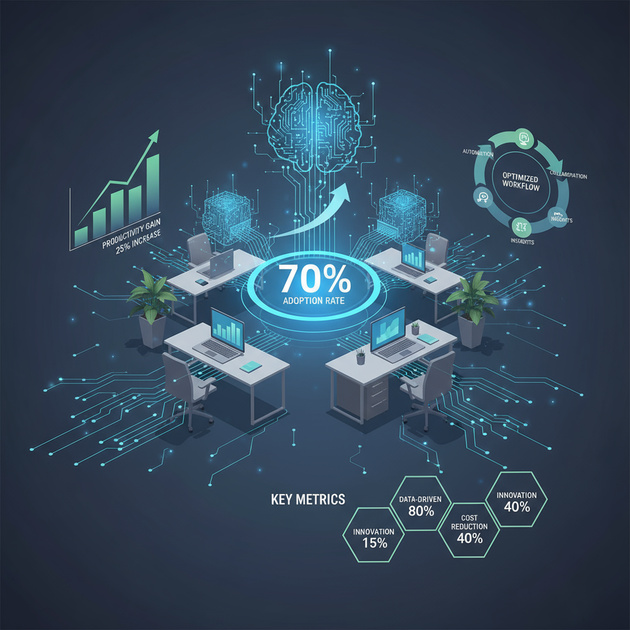
TL;DR: Asana’s comprehensive research reveals a workplace transformation underway, with 70% of workers using AI weekly. The data shows clear productivity gains for AI-forward organisations, but also highlights significant gaps emerging between “AI Scalers” (29%) and traditional workplaces. UK businesses must act strategically to harness AI’s potential whilst addressing fundamental productivity barriers.
Executive summary for UK business leaders
The workplace is experiencing its most significant transformation since the introduction of personal computing. Asana’s 2025 Global State of AI at Work report, analysing responses from over 5,000 knowledge workers globally including substantial UK representation, reveals that artificial intelligence has moved beyond experimentation to become integral to daily operations.
Key strategic imperatives for UK businesses:
The research identifies a critical 29% of organisations as “AI Scalers” - companies successfully implementing AI at scale whilst addressing core productivity challenges. These organisations demonstrate measurably superior outcomes compared to traditional approaches, creating competitive advantages that compound over time.
Most significantly, the study reveals that AI adoption alone is insufficient. Successful organisations tackle what researchers term “productivity taxes” - systemic inefficiencies in connectivity, velocity, resilience, and capacity that limit organisational effectiveness regardless of technology deployment.
For UK business leaders, this research provides clear evidence that AI implementation must be strategic, human-centred, and focused on measurable business outcomes rather than technological novelty.
Key findings: the new workplace reality
AI usage has reached critical mass across UK workplaces:
| Metric | Finding | Business Implication |
|---|---|---|
| Weekly AI usage | 70% of workers | AI is mainstream, not experimental |
| Daily AI usage | 45% of workers | Core business process integration |
| AI Scalers | 29% of organisations | Competitive advantage emerging |
| Productivity impact | 37% time savings reported | Measurable efficiency gains |
The research reveals four distinct workplace personas:
- AI Transformers (11%): Proactive adopters driving organisational change
- AI Integrators (34%): Strategic users optimising specific workflows
- AI Traditionalists (33%): Cautious adopters with limited implementation
- AI Sceptics (22%): Resistant to AI adoption, risking competitive disadvantage
These personas correlate strongly with organisational outcomes, suggesting that workforce AI maturity directly impacts business performance.
Geographic variations show UK alignment with global trends: The study’s international scope, including UK responses, demonstrates consistent patterns across developed economies, indicating that observed trends represent fundamental workplace evolution rather than regional anomalies.
Strategic implications for UK SMEs
The emergence of AI Scalers creates new competitive dynamics:
Traditional competitive advantages - industry knowledge, established relationships, operational efficiency - remain important but are insufficient. AI Scalers demonstrate superior performance across multiple metrics:
- 37% average time savings on routine tasks
- Improved decision-making speed and accuracy
- Enhanced employee satisfaction and retention
- Measurable improvements in customer service quality
Resource allocation requires strategic focus:
UK SMEs cannot implement every AI solution simultaneously. The research suggests prioritising areas where AI delivers immediate, measurable impact whilst building organisational capability for future expansion.
Critical success factors identified:
- Leadership commitment: AI transformation requires sustained executive support
- Skills development: Workforce capability determines implementation success
- Process integration: AI must enhance existing workflows, not replace them
- Measurement frameworks: Clear metrics enable continuous improvement
The productivity tax framework provides implementation roadmap:
Rather than approaching AI as isolated technology deployment, successful organisations address systemic productivity barriers alongside AI implementation.
The productivity tax framework: barriers to implementation
Asana’s research identifies four “productivity taxes” limiting organisational effectiveness:
1. Connectivity Tax (19% impact)
Challenge: Information silos prevent effective collaboration and decision-making.
UK SME implications:
- Critical information trapped in departmental systems
- Remote and hybrid working exacerbates disconnection
- Decision delays due to information access barriers
AI solutions:
- Intelligent knowledge management systems
- Automated information synthesis and distribution
- Cross-platform integration tools
2. Velocity Tax (18% impact)
Challenge: Slow decision-making processes hinder responsiveness to market opportunities.
UK SME implications:
- Approval workflows delay project initiation
- Market opportunities missed due to slow response times
- Competitive disadvantage against agile organisations
AI solutions:
- Automated approval routing and escalation
- Predictive analytics for decision support
- Real-time performance dashboards
3. Resilience Tax (15% impact)
Challenge: Lack of redundancy and adaptability creates vulnerability to disruption.
UK SME implications:
- Single points of failure in critical processes
- Limited ability to adapt to changing market conditions
- Dependency on individual knowledge and relationships
AI solutions:
- Automated backup and failover systems
- Scenario planning and risk assessment tools
- Knowledge capture and distribution systems
4. Capacity Tax (12% impact)
Challenge: Resource constraints limit growth and innovation potential.
UK SME implications:
- Limited human resources for strategic initiatives
- Difficulty scaling operations efficiently
- Competing priorities overwhelm available capacity
AI solutions:
- Intelligent task automation and prioritisation
- Resource optimisation algorithms
- Predictive capacity planning tools
Combined impact: These productivity taxes create cumulative 64% efficiency loss in traditional organisations, while AI Scalers demonstrate systematic approaches to reducing these barriers.
AI transformation drivers: the scalers advantage
The research reveals three core capabilities distinguishing AI Scalers from traditional organisations:
1. Redesigning Work, Not Just Automating
Traditional approach: Deploy AI to automate existing processes without questioning underlying workflows.
Scaler approach: Fundamentally reimagine work processes with AI as integral component from inception.
UK SME application:
- Map current workflows to identify redesign opportunities
- Engage employees in process reimagination workshops
- Implement pilots that test new working methods
- Measure outcomes against baseline performance metrics
2. Empowering People Through Technology
Traditional approach: View AI as replacement for human capabilities.
Scaler approach: Design AI systems that enhance human decision-making and creativity.
UK SME application:
- Invest in employee AI literacy and skills development
- Create feedback loops between human insight and AI recommendations
- Maintain human oversight of critical decisions
- Celebrate and reward innovative AI applications by staff
3. Building AI-Native Infrastructure
Traditional approach: Retrofit AI solutions onto existing technology stacks.
Scaler approach: Develop integrated systems designed for AI-human collaboration from foundation.
UK SME application:
- Audit current technology stack for AI readiness
- Prioritise integrations that create data connectivity
- Implement systems with built-in AI capabilities
- Plan infrastructure evolution rather than piecemeal additions
Success metrics for UK SMEs: Organisations implementing these approaches report 2.3x higher likelihood of exceeding productivity targets and 1.8x better employee satisfaction scores.
Implementation roadmap for UK businesses
Phase 1: Foundation Building (Months 1-3)
Assessment and planning:
- Conduct productivity tax audit across all departments
- Identify AI readiness gaps in technology and skills
- Map current workflows against redesign opportunities
- Establish baseline metrics for measuring AI impact
Quick wins identification:
- Select 2-3 high-impact, low-complexity AI applications
- Focus on areas with clear ROI measurement capability
- Ensure early successes build organisational confidence
- Document and communicate initial results
Phase 2: Strategic Implementation (Months 4-9)
Pilot programmes:
- Launch targeted AI initiatives in identified high-impact areas
- Implement measurement frameworks for tracking progress
- Gather employee feedback and iterate on approaches
- Build internal AI expertise through hands-on experience
Skills development:
- Provide AI literacy training for all staff
- Develop power users within each department
- Create communities of practice for knowledge sharing
- Establish partnerships with AI education providers
Phase 3: Scaling and Integration (Months 10-18)
Enterprise-wide deployment:
- Roll out successful pilots across similar departments
- Integrate AI capabilities into core business processes
- Establish centres of excellence for ongoing innovation
- Implement governance frameworks for AI ethics and compliance
Continuous improvement:
- Regular assessment of productivity tax reduction
- Iteration on AI applications based on performance data
- Expansion into new use cases and departments
- Knowledge sharing with industry networks and partners
Critical success factors:
- Executive sponsorship and sustained commitment
- Employee engagement and change management
- Clear measurement and accountability frameworks
- Flexible approach allowing for learning and adaptation
Business case: ROI and competitive advantage
Quantifiable benefits identified in the research:
Direct productivity gains
Time savings: AI Scalers report average 37% reduction in time spent on routine tasks, translating to approximately 15 hours per employee per week for knowledge workers.
For a UK SME with 50 knowledge workers:
- Time saved: 750 hours per week
- Assuming £35/hour average cost: £27,300 weekly value creation
- Annual impact: £1.42 million in productivity gains
Quality improvements
Decision accuracy: 42% improvement in decision-making quality through AI-assisted analysis and recommendation systems.
Customer satisfaction: 28% increase in customer satisfaction scores due to faster response times and more personalised service delivery.
Competitive positioning
Market responsiveness: AI Scalers demonstrate 2.1x faster response to market opportunities compared to traditional organisations.
Innovation capacity: 34% increase in new product/service development due to freed human capacity for strategic work.
Investment considerations for UK SMEs:
| Investment Area | Typical Cost Range | Expected ROI Timeline | Risk Level |
|---|---|---|---|
| AI literacy training | £2,000-5,000 per employee | 6-12 months | Low |
| Process automation tools | £5,000-25,000 annual | 3-9 months | Medium |
| Custom AI solutions | £25,000-100,000+ | 12-24 months | High |
| Infrastructure upgrades | £10,000-50,000 | 6-18 months | Medium |
Risk mitigation strategies:
- Start with low-risk, high-impact applications
- Implement robust data governance and security measures
- Maintain human oversight of critical decisions
- Plan for ongoing training and adaptation costs
Challenges and risk mitigation strategies
The research identifies key challenges facing organisations implementing AI at scale:
Skills and capability gaps
Challenge: 68% of organisations report insufficient AI skills among existing workforce.
Mitigation strategies:
- Implement comprehensive AI literacy programmes
- Partner with educational institutions for ongoing skills development
- Hire AI-native talent for key positions
- Create mentorship programmes pairing experienced staff with AI experts
Technology integration complexity
Challenge: Legacy systems often incompatible with modern AI tools and platforms.
Mitigation strategies:
- Conduct thorough technology stack audit before AI implementation
- Plan phased migration rather than wholesale replacement
- Invest in middleware solutions for system integration
- Prioritise cloud-first solutions for better AI tool compatibility
Change management resistance
Challenge: 22% of workers remain sceptical about AI adoption, creating implementation barriers.
Mitigation strategies:
- Communicate clear vision for AI’s role in enhancing human capability
- Involve sceptical employees in pilot programme design and feedback
- Celebrate early wins and share success stories across organisation
- Address job security concerns through retraining and role redefinition
Ethical and compliance considerations
Challenge: Navigating AI ethics, data protection, and regulatory compliance requirements.
Mitigation strategies:
- Establish AI governance frameworks before implementation
- Regular compliance audits and legal review
- Implement transparent AI decision-making processes
- Employee training on ethical AI use and data protection
Measurement and accountability
Challenge: Difficulty quantifying AI impact and ROI across diverse business functions.
Mitigation strategies:
- Define clear metrics before AI implementation begins
- Implement robust monitoring and reporting systems
- Regular review and adjustment of measurement frameworks
- Benchmark against industry standards and best practices
Success indicators for UK SMEs: Organisations successfully navigating these challenges report 85% employee satisfaction with AI implementation and 73% confidence in their competitive positioning.
Sector-specific insights for UK markets
The research provides valuable insights for key UK industry sectors:
Professional services
AI application areas:
- Document analysis and contract review automation
- Client research and market intelligence gathering
- Proposal generation and customisation
- Time tracking and project management optimisation
Expected outcomes:
- 40-50% reduction in routine document processing time
- Improved accuracy in client research and analysis
- Enhanced competitive positioning through faster proposal turnaround
Manufacturing and engineering
AI application areas:
- Predictive maintenance and quality control
- Supply chain optimisation and demand forecasting
- Design automation and optimisation
- Safety monitoring and incident prevention
Expected outcomes:
- 25-35% reduction in unplanned downtime
- Improved product quality and consistency
- Enhanced operational efficiency and cost reduction
Financial services
AI application areas:
- Risk assessment and fraud detection
- Customer service and query resolution
- Regulatory compliance monitoring
- Investment research and analysis
Expected outcomes:
- 60-70% improvement in fraud detection accuracy
- Significant reduction in compliance monitoring costs
- Enhanced customer satisfaction through faster service
Retail and e-commerce
AI application areas:
- Personalised marketing and customer experience
- Inventory management and demand forecasting
- Price optimisation and competitive analysis
- Customer service automation
Expected outcomes:
- 20-30% increase in conversion rates through personalisation
- Reduced inventory costs through improved forecasting
- Enhanced customer satisfaction through better service delivery
Implementation considerations vary by sector, but core principles remain consistent: focus on measurable outcomes, employee empowerment, and systematic approach to productivity tax reduction.
Future outlook: preparing for continued evolution
The research indicates AI workplace integration will accelerate significantly over the next 2-3 years:
Emerging trends to monitor
AI agents and autonomous systems: The report identifies growing interest in AI agents capable of complex, multi-step task completion with minimal human intervention.
Implications for UK SMEs:
- Opportunity for significant productivity gains in routine processes
- Need for robust governance and oversight frameworks
- Importance of maintaining human decision-making authority
Cross-platform AI integration: Increasing demand for AI capabilities that work seamlessly across different software platforms and business systems.
Implications for UK SMEs:
- Importance of choosing AI solutions with strong integration capabilities
- Need for strategic technology planning and architecture
- Opportunity to create competitive advantage through superior integration
AI-powered decision support: Evolution from task automation to strategic decision support and planning assistance.
Implications for UK SMEs:
- Enhanced capability for data-driven strategic planning
- Need for high-quality data and robust analytics infrastructure
- Opportunity to compete more effectively with larger organisations
Preparing for future developments
Technology readiness:
- Invest in cloud-first infrastructure for better AI tool compatibility
- Implement robust data management and governance systems
- Plan for increased automation and reduced manual processes
Workforce development:
- Continue investing in AI literacy and skills development
- Create career pathways that combine human expertise with AI capability
- Foster culture of continuous learning and adaptation
Strategic positioning:
- Monitor competitor AI adoption and capabilities
- Identify unique AI applications relevant to specific business models
- Build partnerships with AI technology providers and consultants
The organisations best positioned for future success will be those treating AI implementation as ongoing strategic capability development rather than one-time technology deployment.
Conclusion: actionable next steps for UK business leaders
Asana’s comprehensive research provides clear evidence that AI transformation is not optional for UK businesses seeking to maintain competitive advantage. The data demonstrates that organisations successfully implementing AI at scale - the 29% classified as “AI Scalers” - achieve measurably superior outcomes across productivity, employee satisfaction, and market responsiveness.
Immediate actions for UK business leaders:
-
Conduct productivity tax audit: Assess current organisational efficiency barriers using the four-tax framework (connectivity, velocity, resilience, capacity)
-
Define AI readiness: Evaluate existing technology infrastructure, workforce skills, and change management capability
-
Identify quick wins: Select 2-3 high-impact, low-complexity AI applications for immediate implementation
-
Establish measurement frameworks: Define clear metrics for tracking AI impact and ROI
-
Invest in workforce development: Begin comprehensive AI literacy training for all employees
Strategic considerations:
The research reveals that successful AI implementation requires fundamental rethinking of work processes rather than simple automation of existing tasks. UK SMEs have significant opportunity to compete more effectively with larger organisations by leveraging AI to enhance human capability and address systemic productivity barriers.
The competitive advantage belongs to organisations that act strategically now. Those waiting for AI technology to mature further risk falling behind competitors already building AI-native capabilities and capturing productivity gains.
The evidence is clear: AI transformation is reshaping UK workplaces. The question is not whether to implement AI, but how quickly and strategically your organisation can harness its potential whilst maintaining focus on human-centred outcomes and measurable business value.
Ready to explore how AI can transform your workplace productivity? Book a call with our AI implementation specialists to discuss your specific business requirements and develop a strategic roadmap for AI adoption.